

A Discipline Learning to React
Over nineteen years, China's International Relations (IR) field has been remade by forces larger than itself.

You can learn a great deal about an academic field from what it chooses to argue about. For most of its first decade, China’s international relations scholarship argued about itself. The defining questions were internal and foundational: whether the discipline’s borrowed concepts could travel, whether there could be a distinctly Chinese theory of international politics, whether a field built on Morgenthau and Waltz and Keohane could ever stop being, in one widely-quoted phrase from the period, a “racecourse and colony” for Western ideas. The energy went into building a discipline.
Then the world broke in, and the field stopped spending most of its attention on its own foundations and started spending it on great-power competition, on the security of China’s periphery, on sanctions and supply chains, on the governance of technologies that did not exist when the field was young. The shift was never announced. It happened the way these things happen, one decision at a time, as scholars chose what was worth gathering a room to discuss — and it is precisely those decisions, accumulated across years, that let us watch it directly.
I have been reconstructing the full agenda of the annual conference of China’s political science and IR community, the large, open, Tsinghua-hosted gathering that has run every July since 2009. The reconstruction now covers past seventeen editions, 2010 through 2026: 1,593 panels, more than ten thousand participation records, 941 institutions, over four thousand named scholars.
The approach is not original to me. Li Wei and Song Yiming pioneered reading this conference as a window onto the discipline in a 2017 study — but their data ran to the ninth edition, which is to say through 2016. The ten editions that follow are the payload. They cover the exact decade in which the turn those authors only glimpsed became the field’s organizing principle, and almost everything that follows is an inference the older data could not support.
One caution belongs up front. The conference is not a mirror of Chinese IR as a whole; it overrepresents elite institutions, Beijing networks, and the scholars with standing access to the annual community. But that skew is the instrument, not a flaw in it: the conference is a sensor for the field’s agenda-setting core, the cluster whose choices about what is worth studying tend to become, a few years on, what the discipline as a whole is doing. Read that way, the post-2016 agenda tells a coherent story, and it is a story about a knowledge system increasingly shaped from the outside in — reacting faster and at larger scale every cycle, through a base that does not change.
When the world broke in, and broke in again
The cleanest way to see the shift is through the field’s standard three-way division — IR theory and method, international security, and international political economy. For the conference’s early years, theory dominated; in Li Wei and Song Yiming’s count of the first nine editions, theory took 57 percent of the panels in those three fields, security 26, political economy a thin 16. But the floor was already tilting under them, and the full record shows where the line crossed. In the 2014 to 2016 window, for the first time, security panels outnumbered theory panels — by a single panel, sixty-five to sixty-four. They caught the very start of that crossing. What they could not see is that it was the first of two waves, and the smaller one.
Run the agenda forward through the decade they lacked, and a distinct rhythm appears. The years from 2017 to 2021 — call it the issue-realization phase — are when the field metabolized the shock of open Sino-American rivalry; the conference themes of those years read like a chronicle of it, from “world politics in an age of uncertainty” through “great-power competition and world division.” Theory panels in those years rise to 113, but security and political economy rise with them, to 69 each.
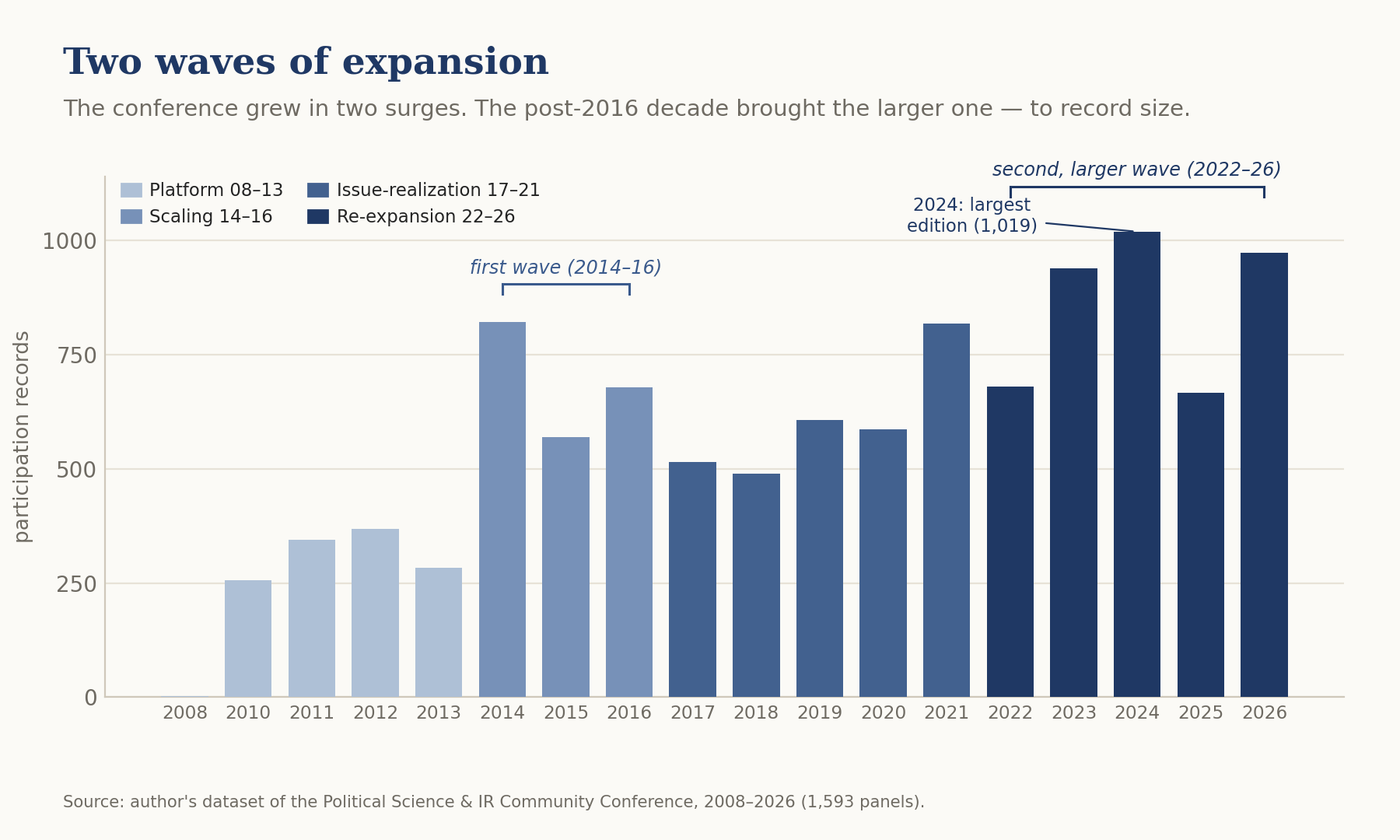
Then, from 2022, the field does not settle. It re-expands, to record size. The 2024 edition is the largest ever held, with more than a thousand participation records; the 2026 edition is the densest, packing more scholars into each panel than any before it. And the second wave is organized around the world, not around theory. In the 2022–2026 phase, theory panels reach 179, but security climbs to 105 and political economy to 87 — both at all-time highs. The foundational impulse never died, and theory remains the single largest field across the whole record. But the growth, in the decade that matters, was led by the fields that face outward.
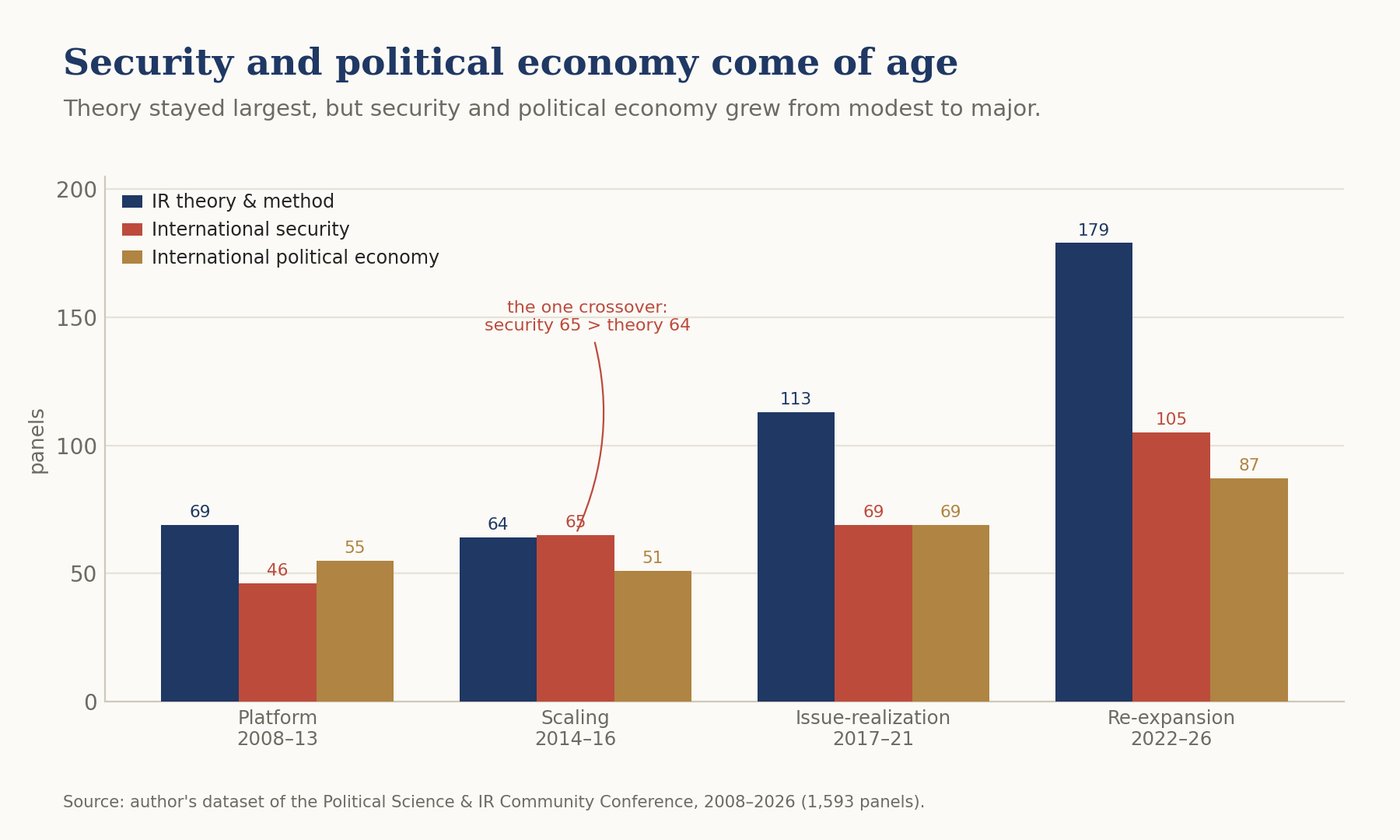
One reversal inside this is worth pausing on, because Li Wei and Song Yiming flagged its absence. They lamented the weakness of international political economy, which they found living “in the cracks between economics and security.” In the newer data it has nearly closed the gap with security. The reason is the same reason for everything else here: as economic statecraft, supply-chain security, sanctions, and technology competition became central strategic questions after 2018, the political economy they had pronounced weak acquired exactly the security relevance it lacked. It was corrected not by maturing on its own terms but by the world making it strategic.
The accelerating clock
If the field has become reactive, the sharper finding from the newer data is that it reacts faster every cycle. The lag between a shock in the world and its appearance on the agenda has been collapsing, and the clearest evidence is a category that did not exist in Li Wei and Song Yiming’s data at all.
They had given the field a benchmark for its own slowness. The policy world, they noted, had been seized with cybersecurity by 2009, but the topic did not reach the conference agenda until 2015 — a six-year lag they attributed to a technical barrier and to cyber arriving first as a policy concern that academically-minded scholars were slow to take up.
Hold that six-year figure against what the newer data shows. Supply-chain and industrial-security panels appear for the first time in 2022, the same year supply chains became an acute strategic anxiety in the wake of the pandemic and the Russo--Ukrainian war — a lag of essentially zero. The technology cluster those authors had seen as a lagging niche, a handful of cyber and big-data panels, has by the most recent editions grown into one of the largest emerging categories in the field, spanning digital governance, artificial intelligence, semiconductors, and technology competition. The mechanism behind this was never mysterious, and they named it: emerging issues rise when national policy pushes them, when leading scholars champion them, when specific institutions get behind them. What the newer data adds is the speed at which that machinery now runs. A field that once needed six years to notice a shock now notices it in the same year. It has built, without anyone designing it, a faster reflex for whatever the world makes urgent next.
2022, all at once
The most visible external force acting on the field is the state, and the newer data lets us watch it act. The pivot year is 2022, and what makes it a pivot is that several things happen at once. That is the year supply-chain panels are born on the agenda. It is the year the conference meets, months after the invasion of Ukraine, under the theme of the turbulence and adjustment of the international security system. It is the year the field’s second, larger expansion wave begins. And it is the year the Ministry of Education redraws the disciplinary map, elevating area and country studies and national-security studies to first-level disciplines — the administrative tier that controls funding and degree-granting — while international relations stays a rung below. The redesign was a deliberate push to reorient the field toward the policy-relevant, region-specific, security-focused knowledge the state judged it lacked.
The agenda registers the push from both directions. Its regional attention, long locked in three blocs — China’s own foreign policy by a wide margin, then the United States, then East Asia — has broadened: South Asia now draws as many panels as East Asia, a rebalancing hard to imagine from a 2016 vantage, and Europe, Eurasia, the Middle East, Africa, and even the Arctic now hold real presence, tracking the Belt and Road, the Indo-Pacific contest, and the war in Ukraine.
And the field’s single largest emerging cluster, by the newer data, is not security or technology but the family of topics around global governance, the Global South, and a self-standing Chinese knowledge system — an agenda driven less by any external crisis than by the state’s own post-2016 campaign to give Chinese social science its “subjectivity” back. The content of the field, not just its scale, has turned toward a domestically anchored register.
But the agenda also complicates the obvious reading, in which the state directs and the discipline follows. The field was already turning before the architecture was redrawn. Security overtook theory six years before national-security studies became a discipline; the regional agenda began broadening before area studies was elevated. What the newer data shows is not a discipline waiting for instructions, and not one acting in isolation either, but a field responding to the same political and geopolitical signals the state was responding to — the shocks, the funding priorities, the security discourse — faster than the bureaucracy could formalize them.
The 2022 redesign is best read not as the cause of the turn but as its conversion into architecture: the state ratified, funded, and accelerated an adjustment already underway, and in standing up hundreds of new institutes, took on the risk of diluting the concentrated competence that had been driving it. That risk points to the part of the picture the reactivity story tends to hide.
The base that does not move
Here is the finding that should unsettle any clean narrative of a field transformed. For all the movement in what the conference discusses, the structure of who does the discussing has barely changed at its center — and where it has changed, it has changed in a direction that narrows the field even as it appears to widen it.
Start with the shape of the room. Link any two institutions that share a panel, weight each tie by how often they co-appear, and the most telling result is how little the network divides. Run a community-detection algorithm over it and it refuses to partition cleanly: this is not a federation of regional schools but a single, densely interconnected core with a few weak satellites. The core is unmistakable — the Chinese Academy of Social Sciences, Tsinghua, Renmin, Peking, and China Foreign Affairs University, with Nankai and the University of International Business and Economics close behind — and the single densest connection in the entire field is the tie between CASS and Tsinghua.
Around that center sit two looser groupings that never harden into rivals: a Shanghai–Guangzhou cluster led by Fudan, with Shanghai International Studies, Shanghai Jiao Tong, Sun Yat-sen, and Guangdong University of Foreign Studies; and a foreign-affairs and policy-institute grouping built around Beijing Foreign Studies University, the China Institutes of Contemporary International Relations, the Central Party School, and the China Institute of International Studies. Both orbit the same core. And four scholars — Yan Xuetong, Liu Feng, Sun Xuefeng, and Zhou Fangyin — appear in all seventeen recorded editions, the human spine of a gathering that has changed its agenda far more than its cast.
What is easy to assume, and wrong, is that this fixed center has tightened its grip. It has not; the field has grown around it. The collective share of the top ten institutions actually fell from its early peak — around 55 percent of all participation in the conference’s first years — to the mid-forties, where it has sat since the mid-2010s. Beijing’s share of the room slid on the same path, from roughly 53 percent to 46. The field, in other words, added a periphery: more institutions, drawn from more provinces, each taking a thinner slice.
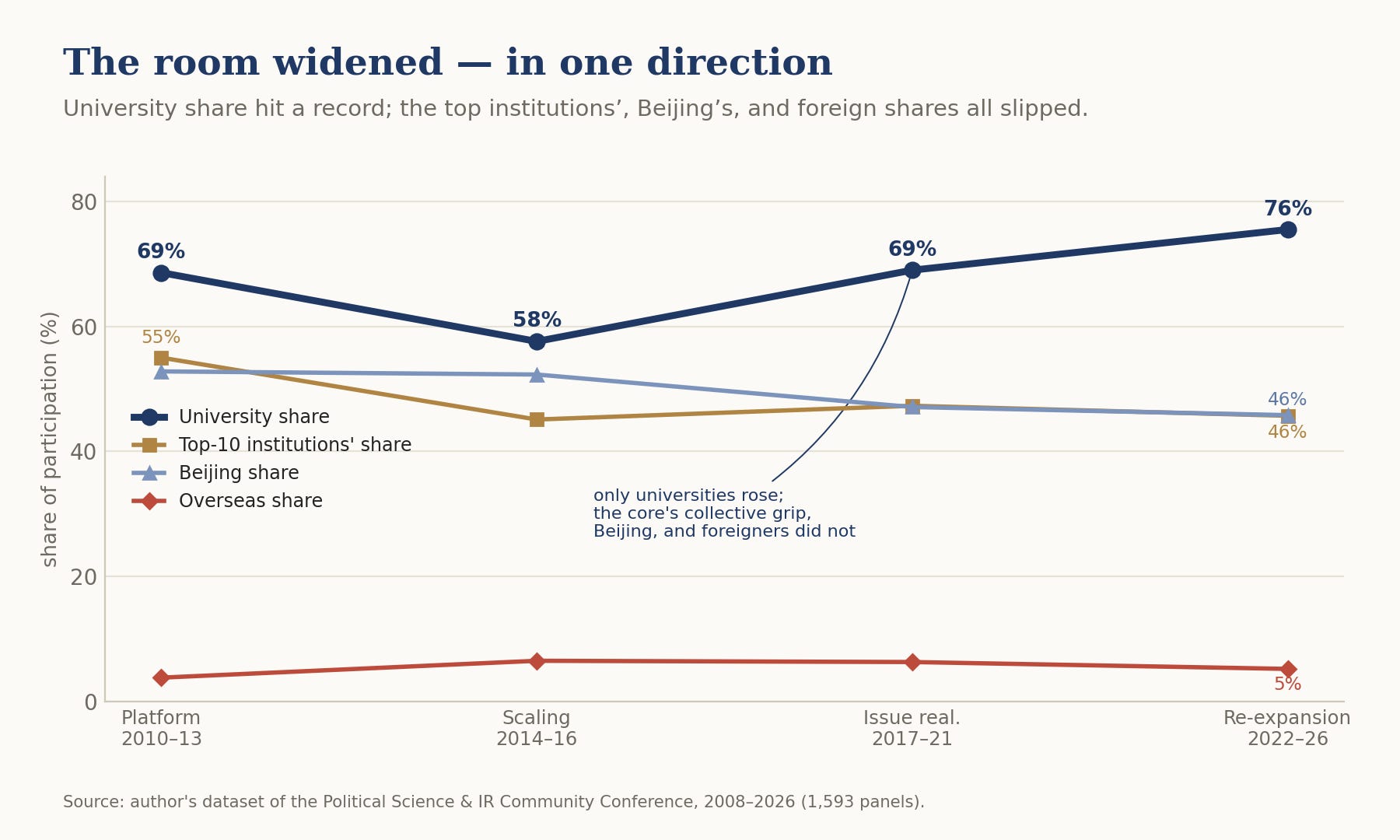
But the periphery it added has a specific character, and that character is what cuts against reading any of this as genuine pluralization. The new entrants are overwhelmingly universities — the university share of participation climbed to 75 percent in the most recent phase, the highest in the dataset, while think tanks and policy institutes fell to 12 percent, their lowest. And they are domestic: international participation, which an earlier generation watched rising toward a peak around 2016, never diffused past a handful of set-piece panels and has receded since. The room broadened, but along one axis only. It became larger, more provincial, more university-bound, and more inward-looking — while the head table, the dense Beijing core and the small group of scholars who convene it, stayed exactly where it was.
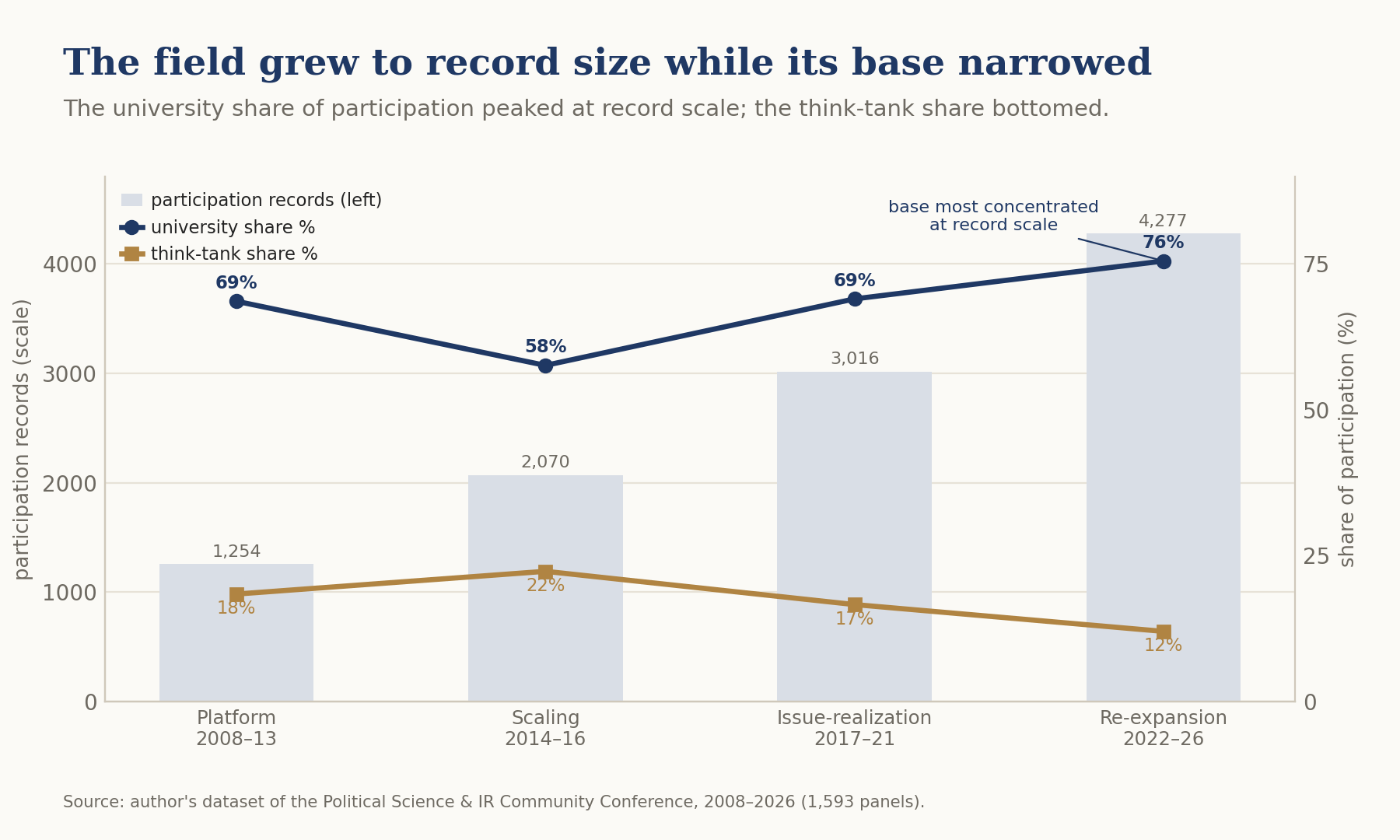
That is the real shape of the base. Not a small group tightening its hold, and not a discipline genuinely opening up, but a fixed center that has acquired a widening margin of provincial universities — attending a conversation it does not yet set. The world supplies more of the questions, and more rooms in more places gather to ask them, but the agenda is still written by the same few institutions in the same city.
What this is the beginning of
Put the newer data together and a coherent dynamic emerges. Across the decade Li Wei and Song Yiming could not see, China’s IR knowledge production became increasingly reactive — its agenda set less by internal intellectual programs than by external pressure, from geopolitical shocks, from the state’s redesign of the discipline, and from the rapid arrival of new global issues. It moved in two waves, the second larger than the first and organized around security, area knowledge, technology, and a self-standing governance agenda. Its reaction time to that pressure shrank from years to months. And all of it ran through a base that stayed small, Beijing-centered, and university-dominated — and, in the years of greatest expansion, grew more concentrated still.
That last tension is what this research program exists to resolve, and it reduces to a single empirical question: does the new agenda diffuse beyond the core, or stay locked inside it? If the security, area-studies, and AI topics the core now convenes begin to appear in the work of provincial universities and the new institutes, the disciplinary expansion is building genuine capacity. If they stay concentrated in the Beijing cluster while the periphery fills quotas, the expansion is manufacturing credentials over a foundation that has not actually widened. The agenda data can be made to answer this, by tracking where topics travel and how fast.
There is a more ambitious version of the same instrument. If shifts in this conference’s agenda reliably precede shifts in the journals, the grant lists, and the policy literature — if a topic surfaces here before it surfaces anywhere else — then the gathering is not merely a record of the field but an early-warning system for it, a place to read where Chinese international relations will turn before it turns. The newer data already shows the pattern in miniature: supply chains and AI arrived on this agenda as they were arriving in the world, ahead of the journals and the institutes built to study them. Testing that lead-time systematically is the work ahead.
For now, the first cut is enough to fix the shape of the question. Over the past decade the field has been learning to react, faster and at larger scale each cycle, to a world and a state that increasingly set its agenda. Whether that reactivity is building a broader discipline or just a quicker one, concentrated in the same few hands, is the thing worth watching next — and the thing this project is built to measure.
This is the opening piece of a research program built on a dataset I am assembling from the full agendas of past seventeen editions of the political science and IR community conference (政治学与国际关系学术共同体会议), 2010–2026. (2008 and 2009 records are not publicly available for now )
It builds on, and extends by a decade, Li Wei (李巍) and Song Yiming’s (宋亦明) 2017 study of the conference’s first nine editions in the Quarterly Journal of International Politics.
Topic coding is keyword-based and directional; claims about diffusion and prediction are hypotheses for the work to come rather than settled results. A companion piece on the institutional politics of the area-studies expansion appears in China Brief Note.