
Snow Blindness
Edgar Snow and the Beacon Tradition in China Watching

Edgar Snow has been dead for fifty-four years. Last week may have been the busiest of his career.
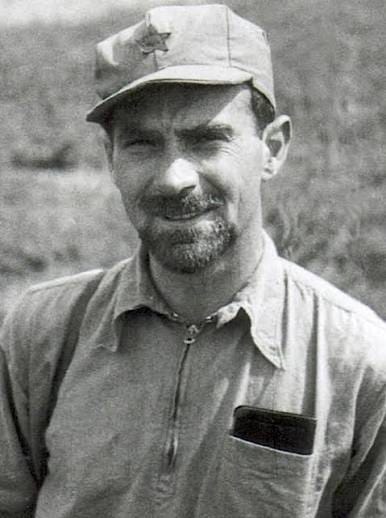
On July 7, Xinhua’s national think tank and Peking University released a sixty-eight-page report on his “spiritual legacy,” timed to the ninetieth anniversary of his 1936 crossing into the Communist base area in China’s northwest.[1] The same week brought a symposium at PKU, a retraced pilgrimage through Yan’an and Ningxia whose walkers included a Snow descendant and the great-grandson of George Hatem, the American doctor who made the 1936 journey at Snow’s side, a Global Edgar Snow Research Program, a new journal, and a database of “international friends.”[2] This is remembrance organized as recruitment, and the posting is nearly explicit: the report closes by calling for “new-era Snows” to go to the scene and tell China’s story to the world.
I happened to be in Beijing the same week, making the coffee rounds that are the liturgy of the newly graduated, while my podcast feed supplied an accidental counter-program: Yuan Li, formerly of The New York Times, and the writer Zha Jianying spent an hour discussing what they called the “China-as-Beacon faction” (中华灯塔派)—a term they said took from my friend 白杰明 (Geremie Barmé)—meaning Westerners who visit China and report that the future is already working there. [3] Their genealogy began with Snow and ended in the post-DeepSeek YouTube feed.
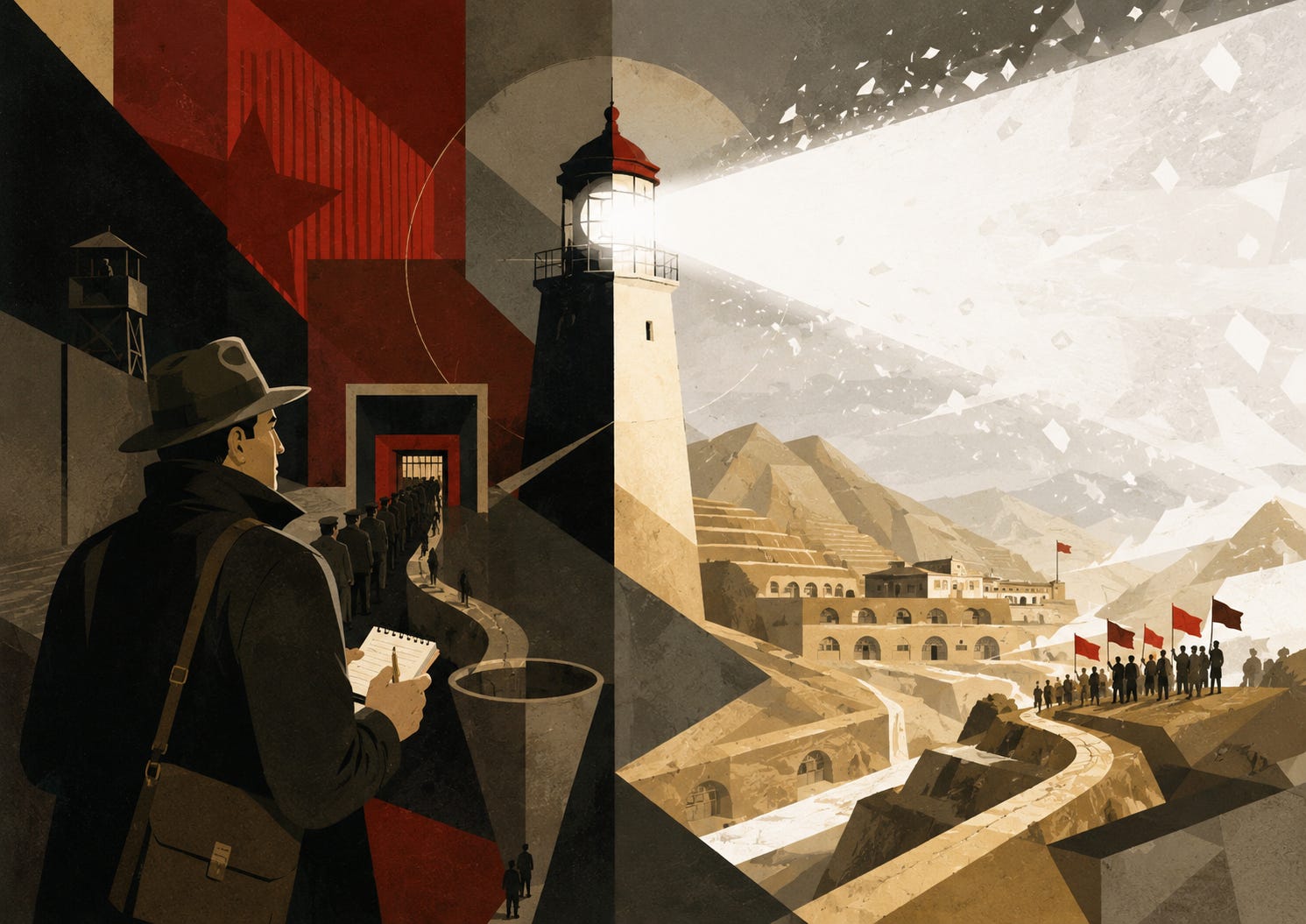
Same week, same corpse, two autopsies with opposite findings. The state reads the lineage as succession, and stages that succession through heredity: descendants on stage, family foundations, friendship administered as an inheritance. The podcast reads it as degeneration, each generation less careful than the last. Yuan Li’s stated credo on the podcast is the Party’s own formula, seeking truth from facts; the Xinhua commentary praises Snow in the same words. The disagreement lies not in the stated standard but in who controls the facts, the access, and the retrospective judgment. Both camps, at least, agree on the metaphor: light.
So here is the claim this essay will defend. Snow’s career shows that foreign testimony becomes unreliable not when access is managed, since most access is, but when access is monopolized: when the host controls what can be seen, and the witness’s professional value comes to depend on being allowed to keep seeing it. Rationed access creates a privileged witness; privilege hardens into professional dependence; dependence erodes falsifiability; and what remains eventually becomes more valuable as a symbol than as testimony. The 2026 campaign seeks to reproduce the prestige of independent witness without reproducing the conditions that once made Snow’s testimony partially credible.
The Prototype of Managed Access
To reach the Red district in June 1936, Snow carried a letter of introduction written in invisible ink, arranged through Sun Yat-sen’s widow Soong Ching-ling. Recognition in Xi’an was by matched halves of a torn calling card. A truck belonging to Zhang Xueliang’s mutinous Northeast Army carried him through a blockade the Nationalists had maintained for nine years. When he finally descended into Bao’an, bugles sounded and the town turned out in formation. It was, he wrote, “the first time a whole city had been turned out to welcome me.” He added: “I was overcome.”[4]
Whether or not anyone designed the journey as an initiation, it functioned as one. A later social-psychology experiment by Aronson and Mills identified a related tendency: costly initiation can increase attachment to the group entered.[5] The blockade obstructed the story, and it also intensified the value Snow attached to the access beyond it. The harder the door, the holier the room.
Then the text. Mao gave Snow roughly ten evenings of autobiography, the only sustained personal history he is known to have offered anyone.[6] The interviews ran through a loop that Snow himself disclosed in print at the time: his English notes were retranslated into Chinese by his interpreter and corrected by Mao, whom Snow credited with an “insistence upon accuracy of detail,” before returning to English.[7] The historian Ishikawa Yoshihiro has reconstructed that loop at document level; Anne-Marie Brady’s archival work shows the hospitality was standing procedure in the Party’s foreign-affairs system rather than improvisation.[8] There was even a co-traveler outside the frame: Hatem accompanied Snow the entire way, and Snow concealed his presence for decades at Hatem’s own request, because Hatem was staying.[9]
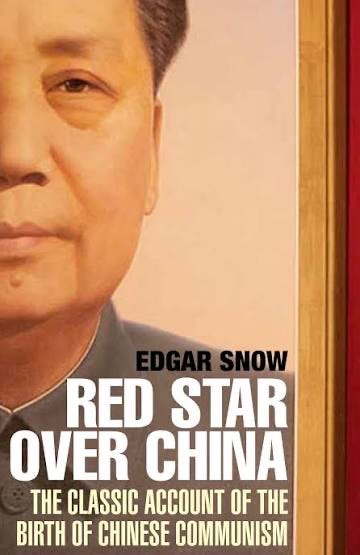
The analytical task is to hold both facts together. The scoop was real; no Western journalist had done what Snow did, and the man he introduced to the world was, contrary to rumor, alive. And Mao was not Snow’s co-author in the ordinary sense, but he participated in verifying and shaping the autobiographical material on which the book’s most influential portrait rested. Managed access did not make Red Star Over China false. It made the book vulnerable, and the size of that vulnerability depended on two variables that would move later: what the host needed the visitor to believe, and how much the visitor needed to come back.
The book also succeeded with two audiences at once, which matters for what follows. In the West, Gollancz’s Left Book Club drove it through three printings; contemporary estimates placed British sales near a hundred thousand copies within a month.[10] In occupied Shanghai, a clandestine publishing collective retitled it Random Notes on a Westward Journey as camouflage; accounts commonly give the first print run as two thousand copies, and memoirists describe young readers carrying it like a passport on the road to Yan’an.[11] Ninety years on, its domestic circulation has been institutionally secured, with the book widely assigned in Chinese middle schools under the national curriculum, while the foreign market for Snow-style authentication largely disappeared generations ago. The 2026 campaign can be read as an attempt to rebuild that lost half: the capacity of a sympathetic outsider to authenticate China for skeptical audiences abroad.

When the Incentives Inverted
The report’s rhetorical centerpiece deserves a name, because it will be reused. Chapter One is titled, literally, “If Snow Revisited China,” and it runs entirely in the subjunctive: if he returned to the northwest, he would see green hills where he once saw yellow dust; he would ride railways he could not have imagined; he would surely be gratified. The report then casts contemporary figures in the roles Snow would supposedly have admired: the youth he “wanted to see but could not have imagined” turn out to be an Olympic snowboarder and a pastoral-lifestyle influencer.
The subjunctive requires a dead witness, because the living one already testified in the indicative. Snow did return: in 1960, readmitted under a reclassification from journalist to writer, and again in 1964 and 1970.[12] The 1960 visit fell in the middle of one of the deadliest famines in modern history. In The Other Side of the River he reported what his method had found: “I diligently searched, without success, for starving people or beggars to photograph.”[13] At that moment a Jesuit priest named László Ladány was counting deaths in the tens of millions from a desk in Hong Kong, working from refugee interviews and the regime’s own provincial radio.[14] The contrast is less presence against absence than curated observation against triangulation: Snow treated a managed field of vision as representative, while Ladány assembled an incomplete but falsifiable picture from sources no host controlled.
The report handles this episode by not mentioning it. Its introduction concedes that Snow “was no prophet,” then its first chapter grades his prophecies and awards full marks. It quotes John Fairbank’s testimonial that the book “stood the test of time,” and omits Fairbank’s fuller verdict, delivered in the same magazine where the prosecution appeared: Snow was “set up by Mao and mugged by the Cold War.”[15] The prosecutor was Jonathan Mirsky, writing in 1989: had the Snow of 1960 still been the reporter of 1936, he would have found the famine.[16]
Moral grading, though, is the least instructive register here, because the mechanism explains more. In 1936 the Communist leadership headed a weak, blockaded movement that urgently needed international recognition: it needed foreigners to know that it existed, held territory, and fought Japan. On those questions, its interests and accurate reporting substantially overlapped, which is why so much of Red Star has held up. By 1960 the incentive had inverted: the ruling Party had an overwhelming reason to obscure precisely the central fact of the moment. Same man, same method: go there, look around, ask the leaders. But the method could no longer distinguish observation from curation, because it had been calibrated for a host that no longer existed.
That is the sentence the new campaign cannot say aloud. Every “new Snow” cultivated through this apparatus enters an incentive structure closer to 1960 than to 1936, with the romance of the earlier journey as the job posting.
The Position Snow Could Not Close
On the podcast, Zha reaches for a moral word for the late Snow: coward. The accounting version is more useful, because it identifies what was preventable.
McCarthyism narrowed Snow’s American market to almost nothing. The FBI questioned him; the Saturday Evening Post relationship that had anchored his income for two decades ended by 1951; Hamilton’s biography traces a decade in which he struggled to place work or make a living from writing in his own country, and in 1959 he moved to Switzerland.[17] He retained his craft, his archive, his reputation. But his most distinctive professional asset, exceptional access to Mao, had become dependent on a single relationship whose renewal Beijing controlled. Economists call the situation lock-in.
Lock-in does not absolve him, and it was not the only pressure on his judgment: ideological sympathy, personal loyalty, and revulsion at American anti-communism mattered too. What lock-in did was make each of those pressures professionally expensive to resist. Hamilton adds the psychological corollary: a positive picture of China validated everything Snow had staked his name on since 1936. He still chose what to ask, what to omit, and what to publish. The famine chapters were written by a free hand attached to an unfree position.
By 1970 the reporter had been compressed into a channel. On October 1 he stood beside Mao on the Tiananmen rostrum, the first American ever placed there, a signal aimed at Washington that Washington failed to read; Kissinger conceded decades later that the message “failed.”[18] In December, Mao told him across five hours that Nixon could come “either as a tourist or as the president”; the signal ran in Life the following April.[19] Snow died of pancreatic cancer on February 15, 1972, six days before Air Force One landed in Beijing. Zhou Enlai had sent a Chinese medical team to his house in Switzerland, and on it was George Hatem: the companion erased from the first page of the story, returning thirty-five years later to sit at its author’s deathbed.[20]
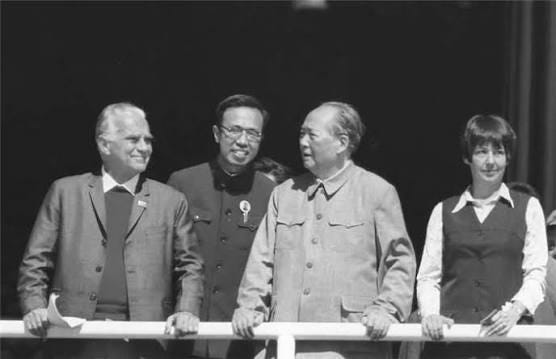
Half the ashes went to the Hudson, half to the lakeside at Peking University. The report calls the grave a silent witness to China’s transformation. It does not mention that in 2000 Snow’s widow, Lois Wheeler Snow, went to Beijing to support the mothers of those killed in 1989, was blocked and followed, and threatened to move her husband’s ashes out of China in protest.[21] The monument’s most eloquent rebuttal came from Snow’s own widow.
Why Beacons Keep Returning
Monopolized access explains the supply of foreign witnesses. Yet a state cannot manufacture an authoritative foreign witness by itself; someone abroad must want to believe him.
The foundational study of that demand remains Harold Isaacs’s Scratches on Our Minds, from 1958. Isaacs interviewed 181 members of the American elite and found the national image of China running on a repeating wheel of benevolence, admiration, disenchantment, and hostility, whose rhythm, he argued, reflected not only events in China but shifts in America’s confidence in itself.[22] Major swells of enthusiasm have often coincided with crises of confidence at home, though each also needed something visible in China to point at. The Depression helped buy Snow’s moment; the 2008 crash expanded the market for the Beijing-model shelf; institutional decay plus the DeepSeek shock, a technological result that revived Western narratives of Chinese state capacity almost overnight, is feeding the current one. Paul Hollander catalogued the Soviet original of the genre and its “techniques of hospitality” four decades ago.[23]
The mirror image completes the picture. Yao Lin has given the name beaconism to the inverse case: Chinese liberals’ idealized America, with the 1988 television series River Elegy as its classic text and the post-2016 years as its disenchantment phase.[24] Two curves, one important shared variable: confidence in one’s own institutions. Zha remembers the view from inside the original. “We were in the lighthouse,” she says of her Beijing childhood: in the dark under the lamp, reading the Little Red Book. A lighthouse is an optical instrument pointed outward; its keepers live in the dark. And staring into reflected light produces the condition called snow blindness: injury caused not by darkness but by excess illumination.
A recent episode offers a useful contrast, though not a proof. In January 2025, the impending TikTok ban and brief shutdown pushed a few hundred thousand Americans onto Xiaohongshu.[25] The contact remained mediated, by algorithms, translation, and self-selection, but it was far less institutionally choreographed than the classic political pilgrimage, and much of the visible interaction centered on grocery bills, homework help, and cat pictures offered as an informal entry tax rather than on regime comparison. Horizontal contact did not eliminate projection, but it diluted the monopoly of the curated itinerary. A Chinese guide who had once escorted Mirsky on his own enthusiastic early visits put the managed alternative in nine words when they met again years later: “We wanted to deceive you. But you wanted to be deceived.”[26]
From Shrine to Ledger
Hence the paradox of last week’s launch. The campaign resembles industrial policy for a reputational good whose value rests on two properties, scarcity and independence, that industrial policy destroys by definition. Snow was worth something because there was one of him, and because readers treated the account as the product of an independent reporter rather than a text whose central autobiographical material had been reviewed by its subject. Once independence became contestable, scarcity had to carry the argument. In six decades the People’s Daily conferred the title “old friend of the Chinese people” on roughly six hundred foreigners.[27] The new program wants volume, with visa policy doing quiet duty alongside it: visa-free transit lowers the cost of producing first-person China content, which official channels can then amplify. A mass-produced foreign friend already has a market name, and the podcast supplied it: influencer.
I do not write any of this from a safe distance. I was trained inside Chinese foreign-policy institutes in Shanghai to make America legible to Chinese readers; I now spend my days making China legible in English. My position is not Snow’s. No state host clears my copy, and no single gatekeeper controls either my access or my income. But the underlying temptation is recognizably his: to convert partial access into general authority, and to become professionally dependent on the very opacity one claims to dispel.
So the real question the anniversary poses is what separates a ledger from a shrine, and the answer is that a ledger’s claims can eventually be settled. Yuan Li recalls once wanting to write down everything the beacon-keepers said and throw it back in their faces someday. Strip the anger off that sentence and what remains is method, predictive accountability, applied first to oneself. It reduces to four tests. Access disclosure: who arranged the visit, chose the interlocutors, translated, paid, and set the limits. Prior recording: what you expected to see, written down before anyone showed you anything. Falsifiability: what evidence would force you to revise the story. Settlement: which of your past calls were wrong, and whether the corrections were made as publicly as the claims. None of this makes curation impossible; it makes retrospective self-exoneration harder. “Show me,” Snow’s Missouri motto, was the most arrangeable request in twentieth-century politics. “Here is what I predicted before you showed me” is much harder to cater.
Snow’s tragedy was never that he loved China too much. He came to hold a position he could not close, and he paid for it in the slow corrosion of his judgment, until two governments valued him more as a symbol than as a reporter. A beacon lights outward; that is its function, not its malfunction. A ledger lights only the desk. It is a smaller instrument, but it is the only one in this trade that lets the keeper see his own errors.
Notes
新华社国家高端智库、北京大学新闻与传播学院:《发现改变中国影响世界的力量——埃德加·斯诺精神遗产的当代价值与世界意义》,2026年7月7日发布(报告全文见中国驻德使馆转载:de.china-embassy.gov.cn/zggs/202607/t20260708_11977892.htm);新华时评《斯诺留给我们的启示》,2026年7月9日。对”新时代斯诺”的呼吁见报告结语与时评。
新华社研究院:《中外嘉宾共话斯诺精神遗产》,2026年7月10日(news.cn/politics/20260710/2d02d366cdc447d1b961b35e158f30ce/c.html),含研讨会、”重走斯诺路”、全球斯诺研究计划、《传播》杂志创刊与国际友人数据库等细节。
不明白播客(Bumingbai Podcast),”中华灯塔派在向往什么?”,主持袁莉,嘉宾查建英,2026年。
Snow’s account of the Bao’an welcome, quoted in S. Bernard Thomas, Season of High Adventure: Edgar Snow in China (University of California Press, 1996).
Elliot Aronson and Judson Mills, “The Effect of Severity of Initiation on Liking for a Group,” Journal of Abnormal and Social Psychology 59 (1959).
On the uniqueness of the autobiographical sessions: Ishikawa Yoshihiro, How the “Red Star” Rose: Edgar Snow and Early Images of Mao Zedong, trans. Joshua Fogel (Chinese University of Hong Kong Press, 2022); Thomas (1996).
Snow’s contemporaneous note on the interview-and-correction procedure, China Weekly Review, November 1936.
Ishikawa (2022); Anne-Marie Brady, Making the Foreign Serve China: Managing Foreigners in the People’s Republic (Rowman & Littlefield, 2003).
Huang Hua’s memoirs record the request by both Hatem and himself not to be named or photographed; see also Thomas (1996) and the standard biographical accounts.
Circulation figures follow John Maxwell Hamilton, Edgar Snow: A Biography (Louisiana State University Press, rev. ed. 2003); they are contemporary estimates, not audited numbers.
On the 复社《西行漫记》 translation (Shanghai, 1938) and its distribution; printing figures vary across sources.
On the 1960 readmission and reclassification: Hamilton (2003).
Edgar Snow, The Other Side of the River: Red China Today (Random House, 1962).
László Ladány, China News Analysis (Hong Kong), August 10, 1962. Later scholarly estimates of famine mortality range from the high teens of millions to over forty million; the figure remains contested.
John K. Fairbank, “Mao and Snow,” New York Review of Books, April 27, 1989 (archived at chinafile.com/library/nyrb-china-archive/mao-and-snow).
Jonathan Mirsky, “Message from Mao,” New York Review of Books, February 16, 1989 (nybooks.com/articles/1989/02/16/message-from-mao/).
Hamilton (2003) on the McCarthy-era income collapse, the FBI file (reproduced in the Edgar Snow Papers, University of Missouri–Kansas City), and the 1959 move to Switzerland.
Kissinger’s concession came in a broadcast interview with Ted Koppel (NPR, May 2011).
Edgar Snow, “A Conversation with Mao Tse-tung,” Life, April 30, 1971.
On the medical team including Hatem: Hamilton (2003); Thomas (1996).
Amy Qin, “Lois Wheeler Snow, Critic of Human Rights Abuses in China, Dies at 97,” The New York Times, April 12, 2018, which recounts the 2000 Beijing episode and the ashes threat.
Harold Isaacs, Scratches on Our Minds: American Images of China and India (1958); see also Raymond Dawson, The Chinese Chameleon (1967).
Paul Hollander, Political Pilgrims (1981), ch. on “the techniques of hospitality.”
Yao Lin, “Beaconism and the Trumpian Metamorphosis of Chinese Liberal Intellectuals,” Journal of Contemporary China 30:127 (2021), doi.org/10.1080/10670564.2020.1766911.
Widely reported in the January 2025 technology press; user-migration totals are platform-period estimates.
The exchange is recounted in Mirsky’s retrospective writing on his early trips to China; wording follows his account.
《南方周末》2011年对《人民日报》1949–2010年用法的统计:601人,来自123个国家。该称号无单一官方名册,此为报纸用法计数。
Further reading
Ishikawa Yoshihiro, How the “Red Star” Rose (CUHK Press, 2022); Anne-Marie Brady, Making the Foreign Serve China (2003); John Maxwell Hamilton, Edgar Snow: A Biography (LSU Press, 2003); S. Bernard Thomas, Season of High Adventure (California, 1996); Paul Hollander, Political Pilgrims (1981); Harold Isaacs, Scratches on Our Minds (1958).