

The Reconstructed City
Reckoning with the disruption of being Chinese

Before I could place China on a map I had already been told what it was: the sole survivor of the four great ancient civilizations, the one continuous thread where Egypt, Babylon, and the Indus had each been broken. The phrasing itself was an inheritance I did not recognize as recent. The category of “the four great ancient civilizations” was popularized by Liang Qichao (梁启超) around 1900, in the same years and out of the same anxiety that produced his other coinage, the Chinese nation (中华民族), an idea engineered to hold the Qing’s fracturing territories and peoples together as a single modern people who could survive in a world he and his contemporaries read through a borrowed Social Darwinism. Yan Fu’s (严复) translation of Huxley had taught that generation that nations competed like species and that the unfit dissolved, and the Ottoman example sat in front of them as the warning. So the continuity I absorbed as ancient fact was, at its origin, a survival strategy roughly a century old, assembled to keep China from going the way of the empires that came apart.
The city I was born in carried the same claim at a smaller scale. Xiangyang (襄阳) announced itself as a famous historical and cultural city with twenty-eight centuries behind its founding, a local franchise of the national five thousand years. My junior high school sat at the center of the old town, ringed by an ancient city wall and a moat, and I would slip out after class to North Street (北街) behind the Zhaoming Gate (昭明台), named for the prince (Xiao Tong, A.D. 501-531) who compiled the canon of literary selections and was born here.
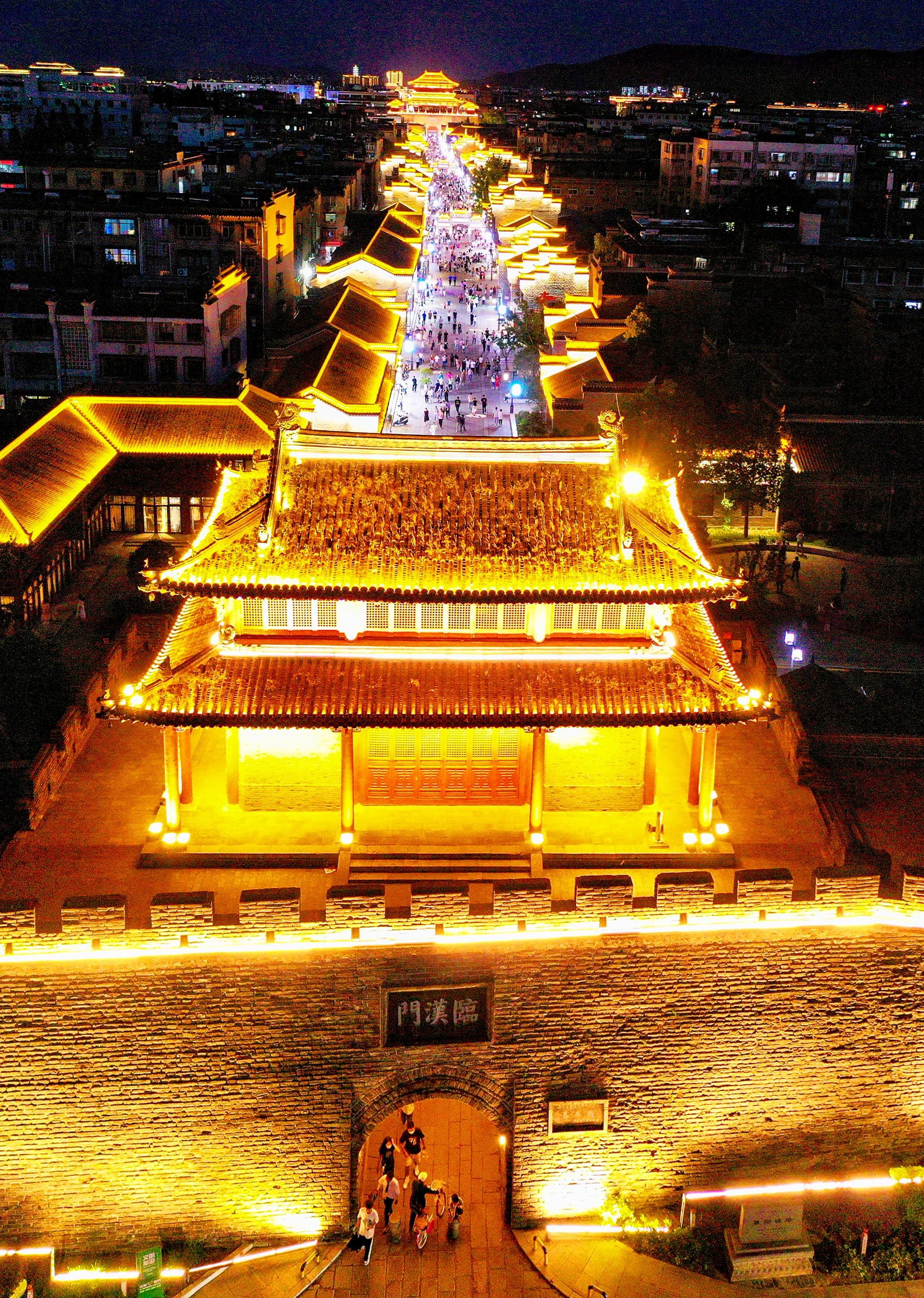
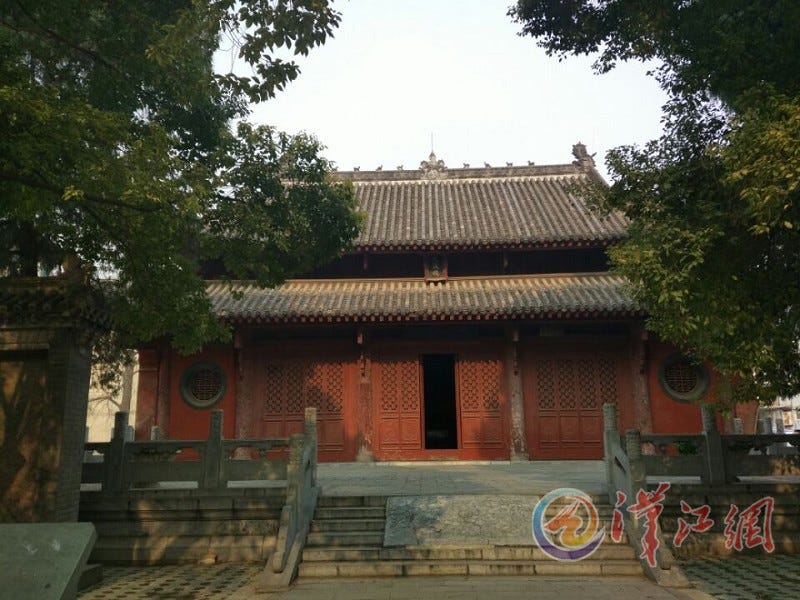
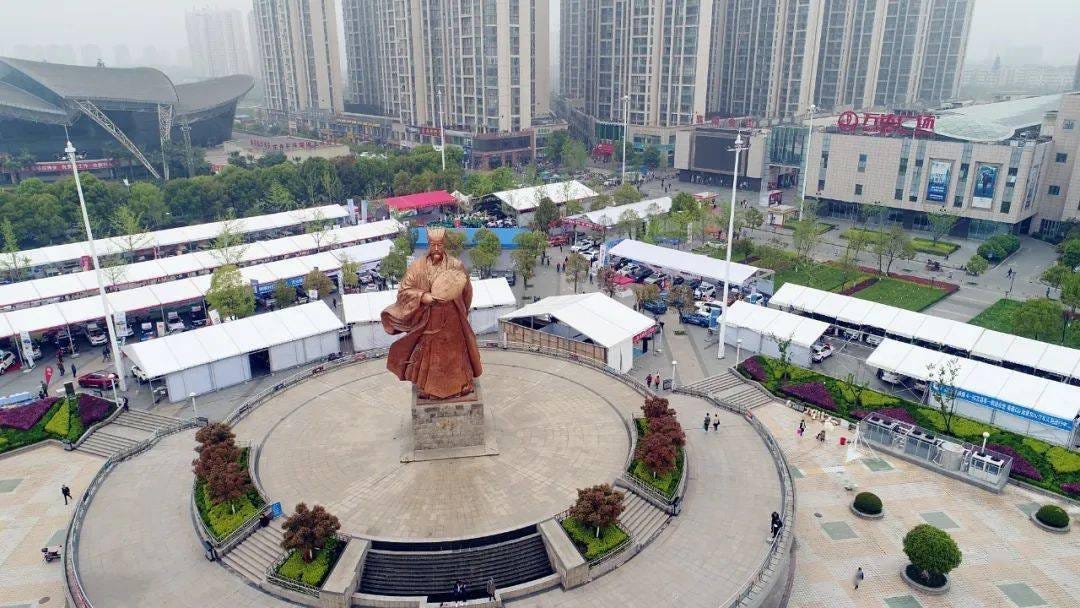
On campus stood a Palace of Great Achievement (大成殿) raised in the Qing years (1822) and now serving as the school museum, and every year before the high school entrance examination you could still watch students cross the Bridge of the Top Scholar (状元桥) to bow before the statue of Confucius for good marks. The web tightened around my own family when my father opened a restaurant and named it after Zhuge Liang (诸葛亮), the Three Kingdoms strategist remade by centuries of retelling into a faultless administrator and a perfectly loyal minister, said to have studied and farmed in the hills outside the city, the precise spot still contested between Xiangyang and neighboring Nanyang because the tourism revenue and the cultural prestige are worth fighting over.
Even the modern and the popular folded back into the same continuous surface. The Nationalist general Bai Chongxi (白崇禧), nicknamed the Little Zhuge, left a post-mortem on losing the city to the Communists in 1948 that read the defeat as a failure of terrain: the heights to the southwest commanded the whole town, Yanggu Hill (羊牯山) stood barely four hundred meters from the southwestern corner where machine guns and artillery could rake the walls, and abandoning those heights was the fatal error, since the positions that held for tens of days on the hills fell in a single day once the defenders pulled inside.
The Hong Kong novelist Jin Yong (金庸) supplied the most enduring popular image of all in The Return of the Condor Heroes (神雕侠侣), where Yang Guo (杨过) defends Xiangyang against the Mongol siege and strikes down the Great Khan beneath its walls, a Han hero holding the line, written for a Cold War Chinese-reading world that was reaching for a renewed sense of Han identity from outside the mainland.
My primary school was dedicated to the memory of Mi Fu (米芾), the Song calligrapher local lore claims as one of its own, and calligraphy practice formed part of a special curriculum. It seemed I had been born into continuity itself, accompanied through every formative year by myth, story, symbol, and history arranged as one unbroken thing.
* * *
The seams showed slowly. When I was set to study classical Chinese (文言文) in junior high it cost me real labor to memorize the passages and to mark the phrasing breaks (句读) for the interpretation tests, and the difficulty was the first clue that this language was less an inheritance than a foreign tongue, a kind of Chinese Latin that the canon before the New Culture Movement (新文化运动) of 1915 had been written in and that almost no one outside a thin scholarly stratum could ever read.
The comparison is gentler than it sounds, since literacy was scarce everywhere before the modern era and a European peasant could no more read Augustine in Latin than my ancestors could read the classics; the difference is what came after. Once Luther’s vernacular and the printing press put scripture into German and English, an ordinary 18th century reader could open the book without a dictionary, while the Chinese vernacular turn arrived only after 1915 and the canon it displaced stayed sealed.
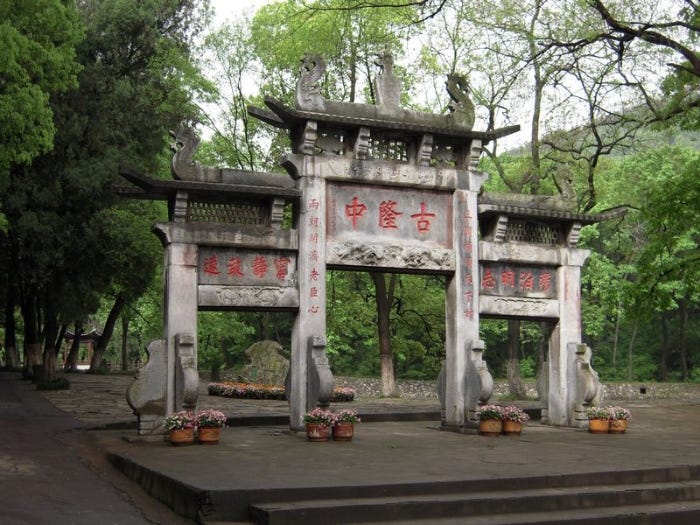
Then the wall itself began to dissolve under inspection. The body of it that I had toured as ancient was substantially Ming, rebuilt and refaced again and again across the centuries until it became hard to say what was left of any original. Nearly every site that carried a state protection plaque had passed through the same process of reconstruction at the “original location,” the shrine to Zhuge Liang at Gulongzhong (古隆中) among them, with Nanyang maintaining its rival version a province away.
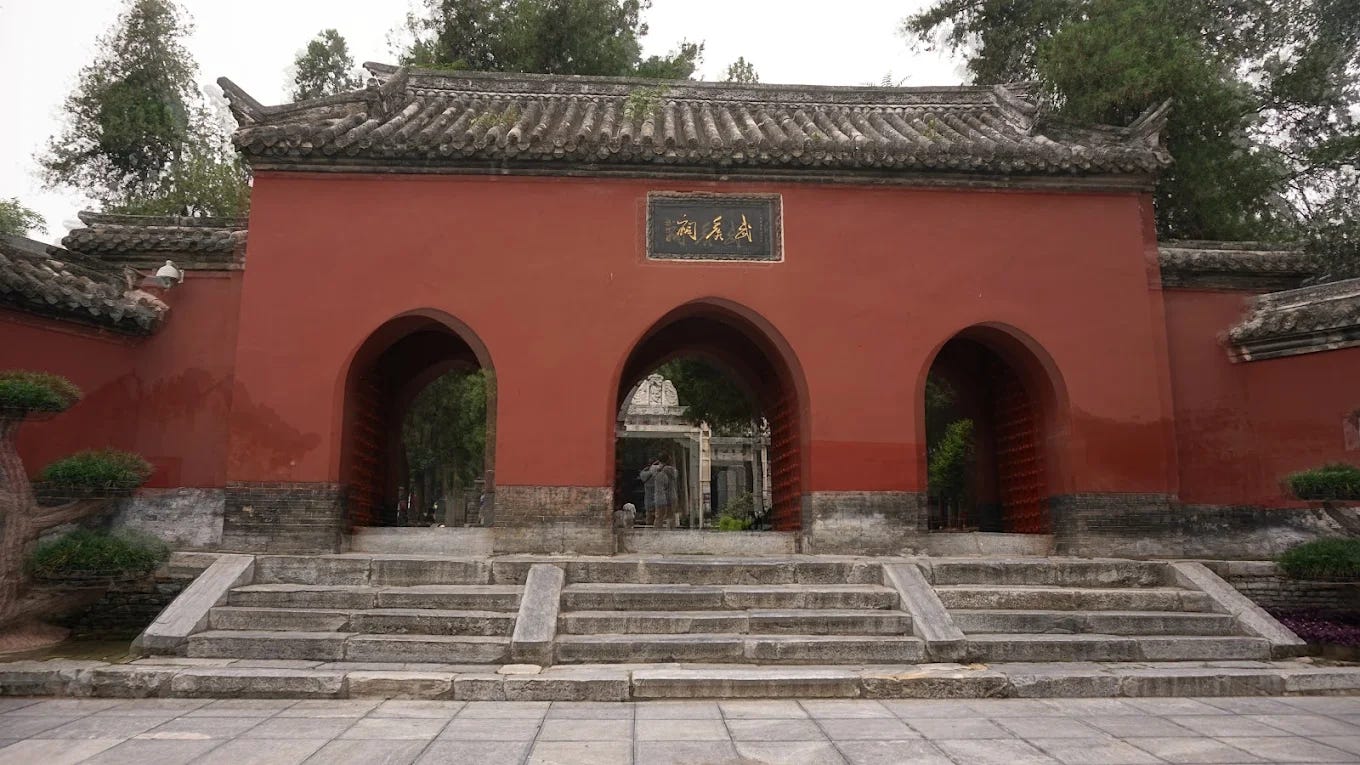
The city’s name had itself been restored by decree: through the late twentieth century it was Xiangfan (襄樊), a compound of Xiangyang on the defensible south bank of the Han River with the hills at its back and Fancheng on the open northern plain that had always been the easier half to take, two places with opposite strategic fates flattened into one administrative word, then unflattened again in 2010 when the old name returned.
* * *
What the seams revealed was rupture: a thin and recent surface stretched over a discontinuous past. From the late Qing onward the city and most of the country were swept by successive waves of revolution, plague, famine, chaos, and the turnover of regimes, so that most families, mine included, can trace their residence in a place back only two generations before the thread frays.
The transformations after 1949 were the most disruptive passage the land had known: the writing system was romanized into pinyin and simplified in its strokes and turned on the page to run left to right, so that the very medium of the past was rebuilt within a single lifetime.
And then the Cultural Revolution arrived to attack continuity directly. The local record is exact about it. In late August 1966 the area’s first Red Guard organization was founded at No. 5 Middle School, my own alma mater, and within days the campaign to smash the four olds and establish the four news swept the whole prefecture; street names, wharf names, shop names, and school names were swapped for revolutionary ones almost overnight, Returning Dragon Road and its wharf becoming East Wind Road and East Wind Wharf, twenty-nine residents’ committees and countless storefronts renamed, whole districts and communes in the surrounding counties relabeled, families taking the lead by destroying their own antiques and the carvings on their own houses.
On a morning at the end of that August the prefectural office learned that several thousand Red Guards had loaded onto trucks and set out for Gulongzhong to carry the campaign to the shrine, and a deputy party secretary named Zheng Shaobo (郑少波) drove there ahead of them and called through a loudspeaker that this was a protected relic and must not be smashed, explaining the consequences until most of the crowd understood and withdrew, which is why the site survived, though the dragon heads on the roof of the Zhuge Liang temple were broken anyway.
So the emblem of the city’s antiquity is a reconstructed shrine to a man whose residence is disputed for tourist money, a shrine that was nearly leveled inside living memory and saved by a cadre with a bullhorn. The result, repeated across the country, is the identical downtown you can now find in any Chinese city, a thousand cities with one face (千城一面), each fitted out with its mandatory antique-style street, a contemporary revival of the vintage standing in for the vintage that was lost.
* * *
I felt the contrast most sharply elsewhere. In Waterloo, Canada, on the new continent, a quiet corner of the town held a small monument to its dead from the First World War with every fallen man’s name set into wood, and near the parking structure by a shopping mall a modest cabinet recorded the town’s emergence in the eighteenth century with an image of its gradual and unbroken path into the present.
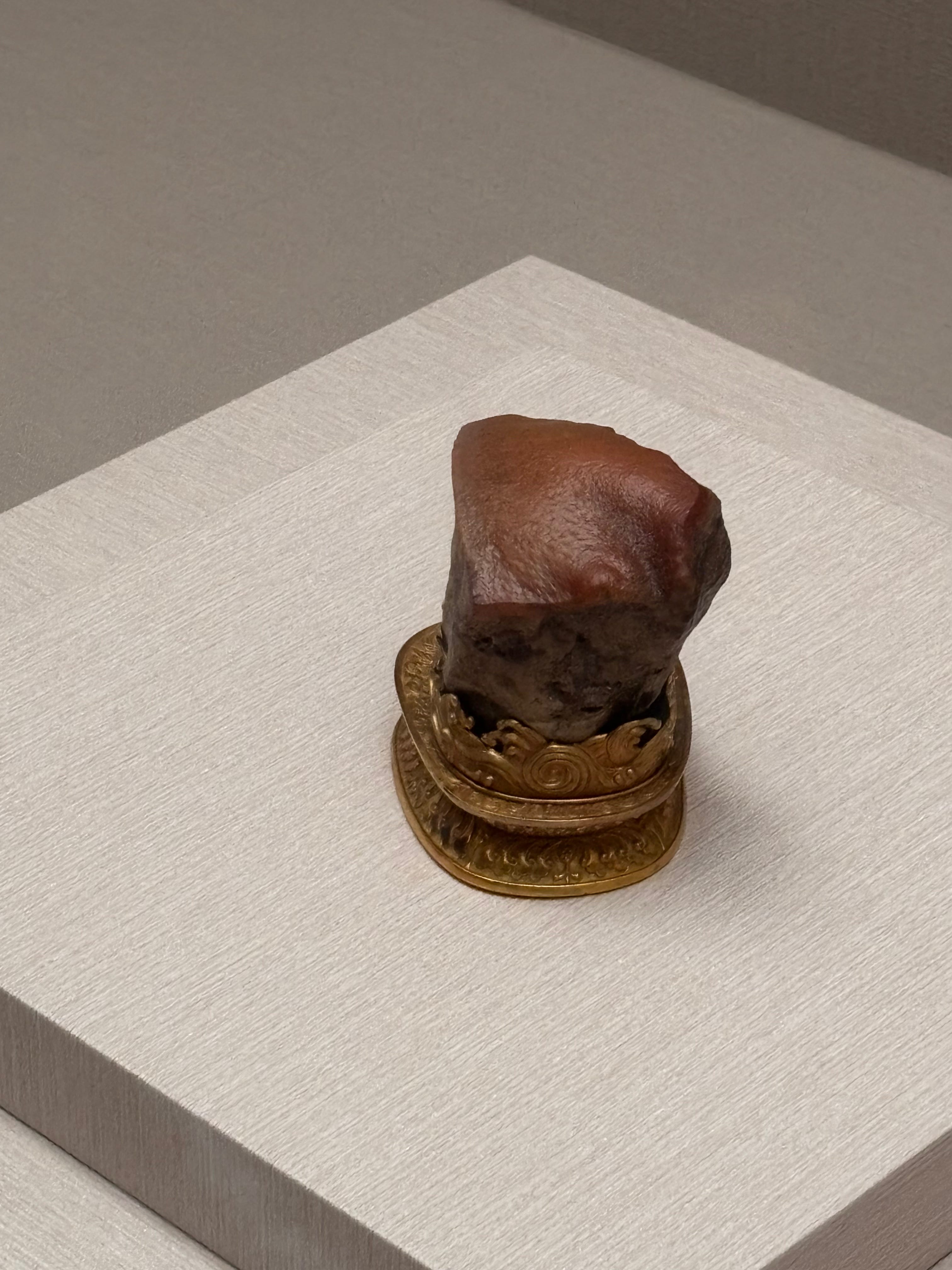
In Taipei I was lucky enough to attend the National Palace Museum’s centennial special exhibition and to stand before the meat-shaped stone (肉形石) and before the calligraphy descending from Su Shi’s writing on the Red Cliff, where a single scroll carried the layered seals and colophons of literati across many generations and dynasties, the object itself a record of its own transmission, every owner and admirer having left a mark on the same surface. I felt close to my own culture and far from it at once, partly because those treasures survived precisely by being carried out of Beijing and across the strait in 1948 and 1949, continuity preserved by flight.
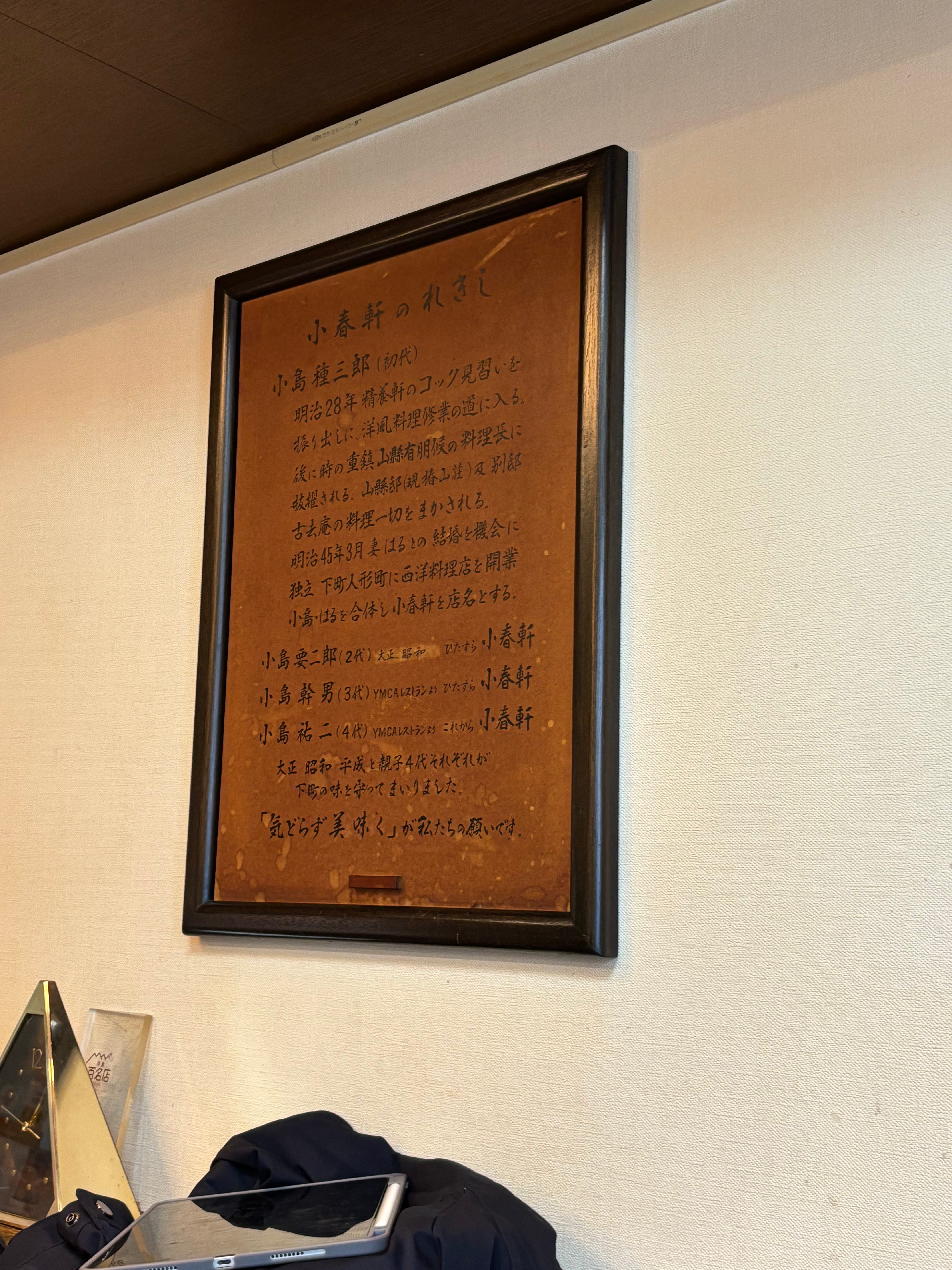
In Tokyo I lived near Nihonbashi and kept passing the Mitsukoshi department store whose lineage runs back to a dry-goods house founded in 1673 and still trading on the same ground, and I ate chicken katsu curry from a shop whose owner traced his family to a first-generation founder who had served as head chef to general who twice served as prime minister of Japan, Yamagata Aritomo (山県有朋). I was also constantly reminded that the bridges and buildings and rail lines around me had been built in the decades after the war, in the fifties and sixties and seventies, and were still standing, which forced the question of what China had been doing in those same years.
As an abstract civilization of symbols China casts a very long shadow, but as a concrete modern polity it is strikingly late, the present republic effectively a second one dating from reform and opening, its modern state-building far younger than Japan’s and its elites and institutions repeatedly shattered by revolution in a way Japan’s were not, to say nothing of the gradual North American modernization that runs back to the seventeenth century.
* * *
It would be too easy to call this hypocrisy, because every nation invents its traditions and edits its past, and the construction of continuity is not in itself the scandal. What is specific to the Chinese case is the combination: an unusually long and insistent claim of unbroken descent laid directly over an unusually recent and violent destruction of the material substrate that elsewhere does the work of memory, so that a society which kept its scrolls and its shops and its war memorials would have less need to keep announcing that it is five thousand years old.
This is what makes China the sharpest instance of compressed modernity, the term Chang Kyung-Sup coined for societies that telescope centuries of change into decades and carry all the resulting contradictions at once. The continuity I was raised inside was hosted not by a building, a family, or a congregation that had recorded a community’s life in organic and material form, but by a state-engineered arrangement of myth, slogan, and “spirit,” and the difference between a remembered past and a curated one is the difference between a scroll that gathered its own seals over centuries and a reconstruction stamped with a single official seal last year.
Which leaves my own generation in a genuinely paradoxical position, and here the reckoning turns personal again. Urban Chinese Gen Z are celebrated as the heirs of a collectivist, classical, “Confucian” heritage and are at the same time among the most individualist, hyper-competitive, and atomized people alive, formed by an examination machine and a labor market that reward the opposite of what the inheritance is said to teach.
And if we insist that the core of Chineseness is the family and the old conviction that of the three unfilial acts the gravest is to leave no heir (不孝有三,無後為大), that a people reproduces itself organically through its descendants, then the deepest disruption is not in the wall or the script or the name of the city but in the body: my generation holds one of the lowest fertility rates in the world, and the mechanism that “Chineseness” names as its biological ground is the one we have most decisively let go.
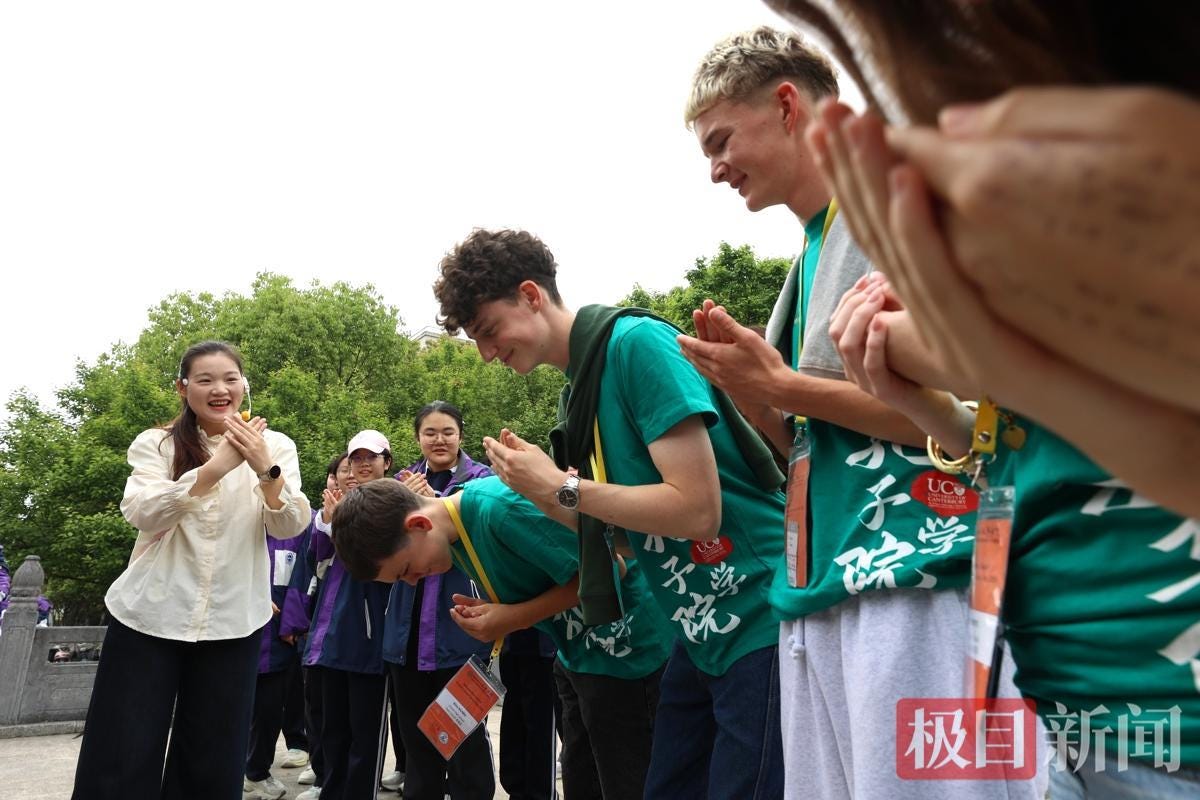
This is the judgment I have come to and have not yet seen stated plainly at home. Continuity and rupture in the Chinese case are not opposites but a single mechanism, because the more thoroughly the material past is erased the more symbolic continuity the state must manufacture to fill the void, and the felt seamlessness of five thousand years is the product of the breakage rather than its refutation.
The demographic turn completes the severance: as the families thin and the descendants are not born, “Chineseness” is cut loose from the biological and material reproduction that once quietly underwrote it, and it survives now mainly as a political and aesthetic category, a citation a state issues rather than an inheritance a community transmits. For the first time the term floats almost entirely free of the things it claims to be made of, and it grows vaguer precisely as it grows louder, which is why someone of my generation can be told daily that he is Chinese and feel the word reaching for him without quite arriving.
Amazing analysis, superbly formulated as always. I like the comparison with Latin, which I studied at school for 7 years. It allows me to read and understand not just Latin but also modern texts written in Spanish and, to a slightly lesser degree, Italian. The difference between Ancient Greek and modern Greek is larger. In my view, the difference is the degree of disruption these countries were exposed to. And still, the continuity over the past 2500 years is obvious for everybody who has studied Latin and/or Greek. This is not to speak of the ancient monuments or ideas that are still with us, from the Akropolis in Athens or the Colosseum in Rome to concepts like history, comedy or dialogue.
I really enjoy your writing. On the paradox of urban Gen Z chinese I was curious whether you think the “chaxugeju” concept from 費孝通is relevant to analyse the impact of the compressed modernization & long heritage.