

The State’s Anonymous Essay
What 338 gaokao prompts reveal about the questions China asks its young, from reform-era humanism to the return of national purpose

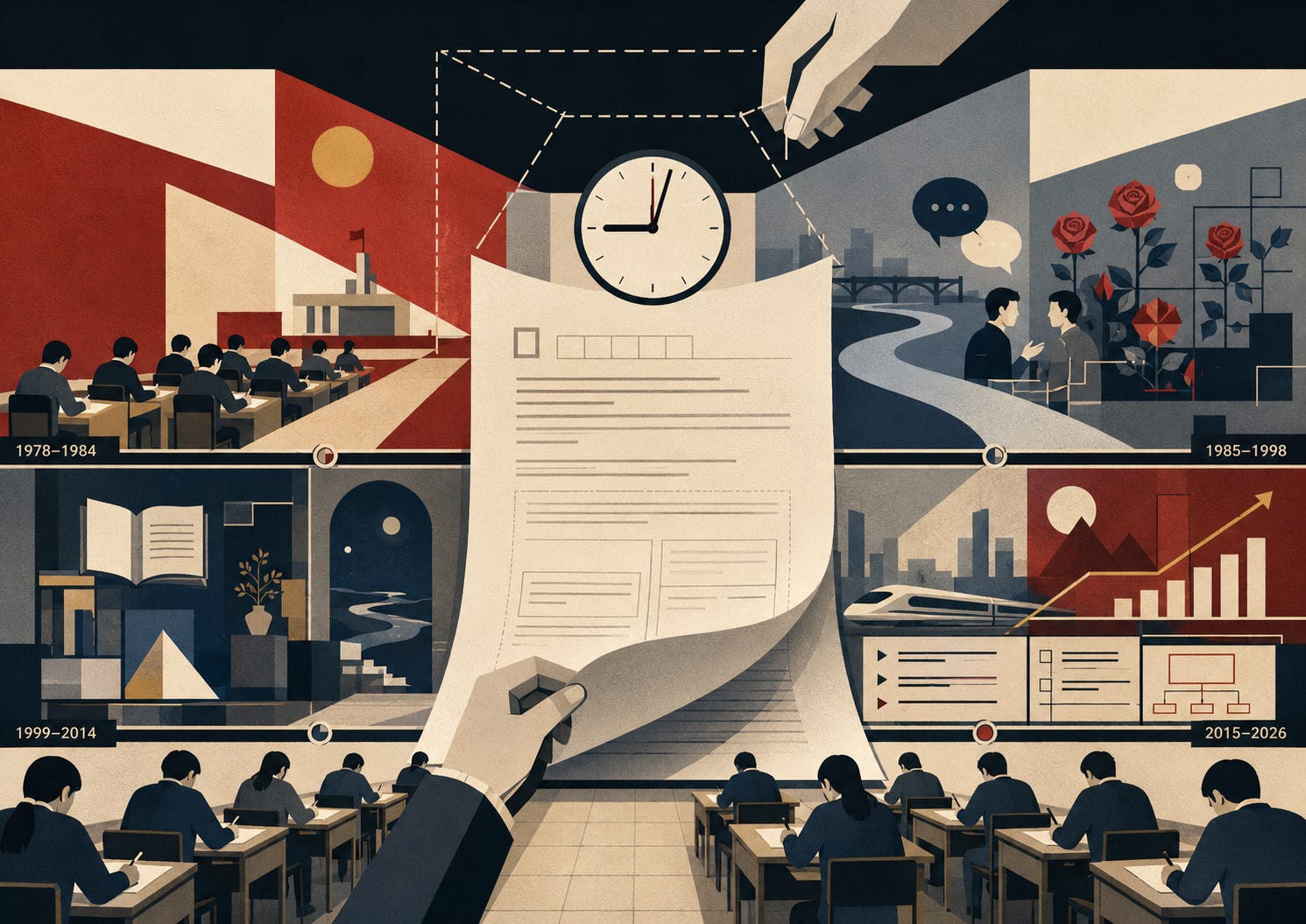
On the morning of June 7, a few minutes past nine, roughly thirteen million Chinese teenagers turn over a sheet of paper and read a short passage followed by an instruction: write an essay of no fewer than eight hundred characters. The passage changes every year. The hour does not. For the length of that hour, the essay prompt of the national college entrance examination, the gaokao, is the most attentively read piece of prose the Chinese state produces. No white paper, no communiqué, no front-page editorial commands an audience of an entire birth cohort reading under maximum stakes, at the same minute, with a pen in hand.
This is why the prompt is worth treating as an archive. A state can say many things about itself in its documents. But what it asks an eighteen-year-old to think about, in the final ritual of secondary education, under conditions where the answer determines a life, is a confession of its intellectual agenda. The question is the tell.
Over the past weeks I built a database of every essay prompt I could reconstruct from the restoration of the gaokao to the present: 338 prompts, 1978 to 2026, plus eight provincial prompts from the improvised winter examination of 1977, when 5.7 million candidates of wildly mixed ages sat for the first exam in a decade and Beijing’s topic was “My Year of Battle.” Each prompt is coded on two independent axes: how prescriptive it is (does it dictate the thesis, the genre, the task?) and whether official discourse enters the text itself, either as unattributed vocabulary or as a signed quotation. Each is tagged for its material source, its themes, its formal requirements, down to the boilerplate at the bottom.
Read in sequence, the corpus is a micro-history of what modern China wanted its educated young to have on their minds. Read structurally, it is a small, unusually clean case study in the sociology of knowledge: Karl Mannheim’s old claim that thought is bound to its social situation, tested on the one genre of Chinese state prose that has been produced continuously, publicly, and under identical institutional conditions for half a century. What follows is that history in four rooms, and then the part the narrative histories miss: the machinery by which the state’s voice actually gets into the question.
Restoration, 1977–1984
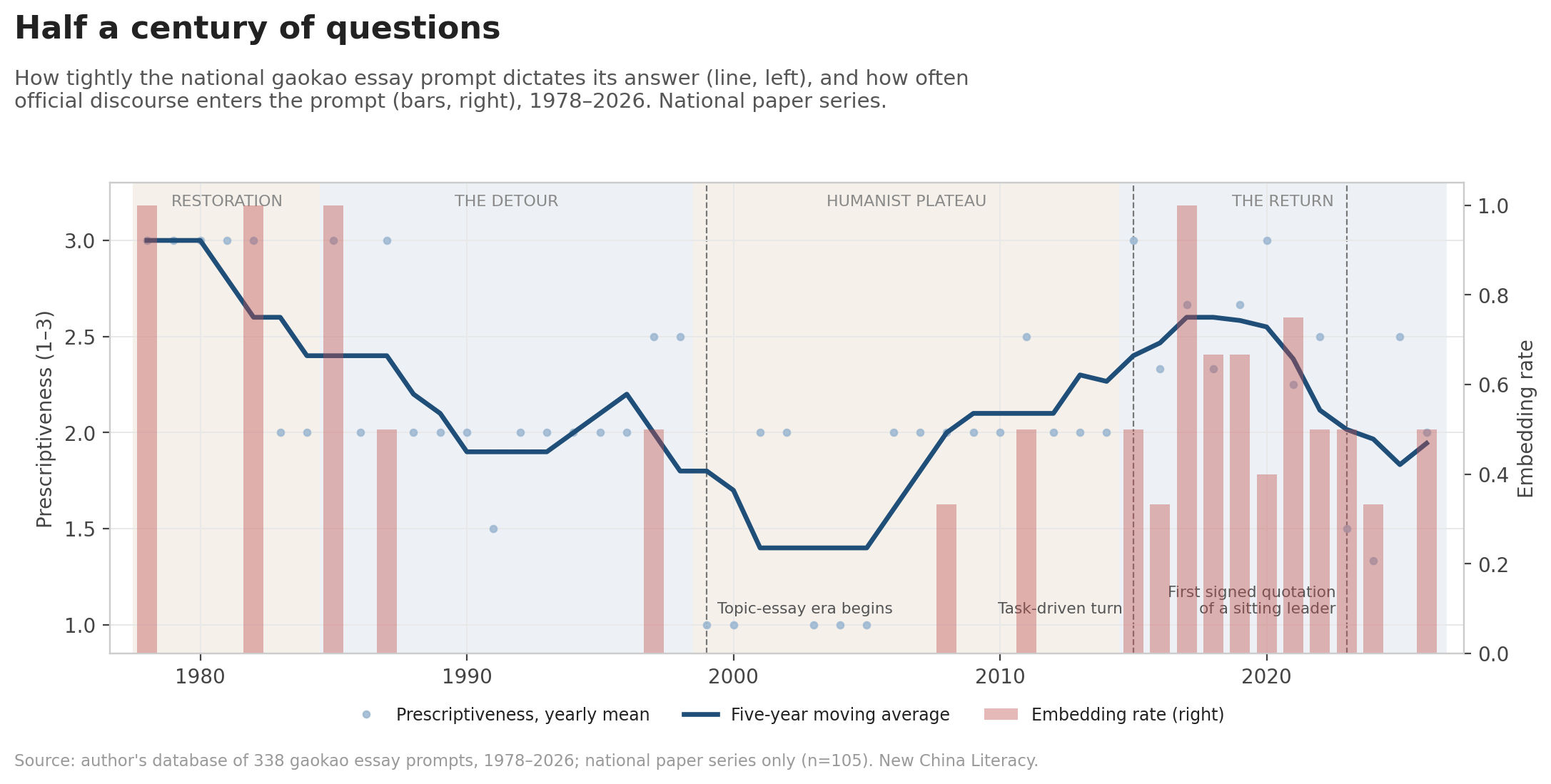
The earliest prompts do not conceal what they are. In 1978 the national task was to condense a political report titled “The Question of Speed Is a Political Question” into a five-hundred-character précis. There was no thesis to choose because the thesis was the material. Prescriptiveness in these years sits at the ceiling of my scale, and every 1977 provincial prompt embeds official language, because the examination itself was a political restoration document: proof, in the form of a question, that order had returned and that the criterion of merit was again textual discipline.
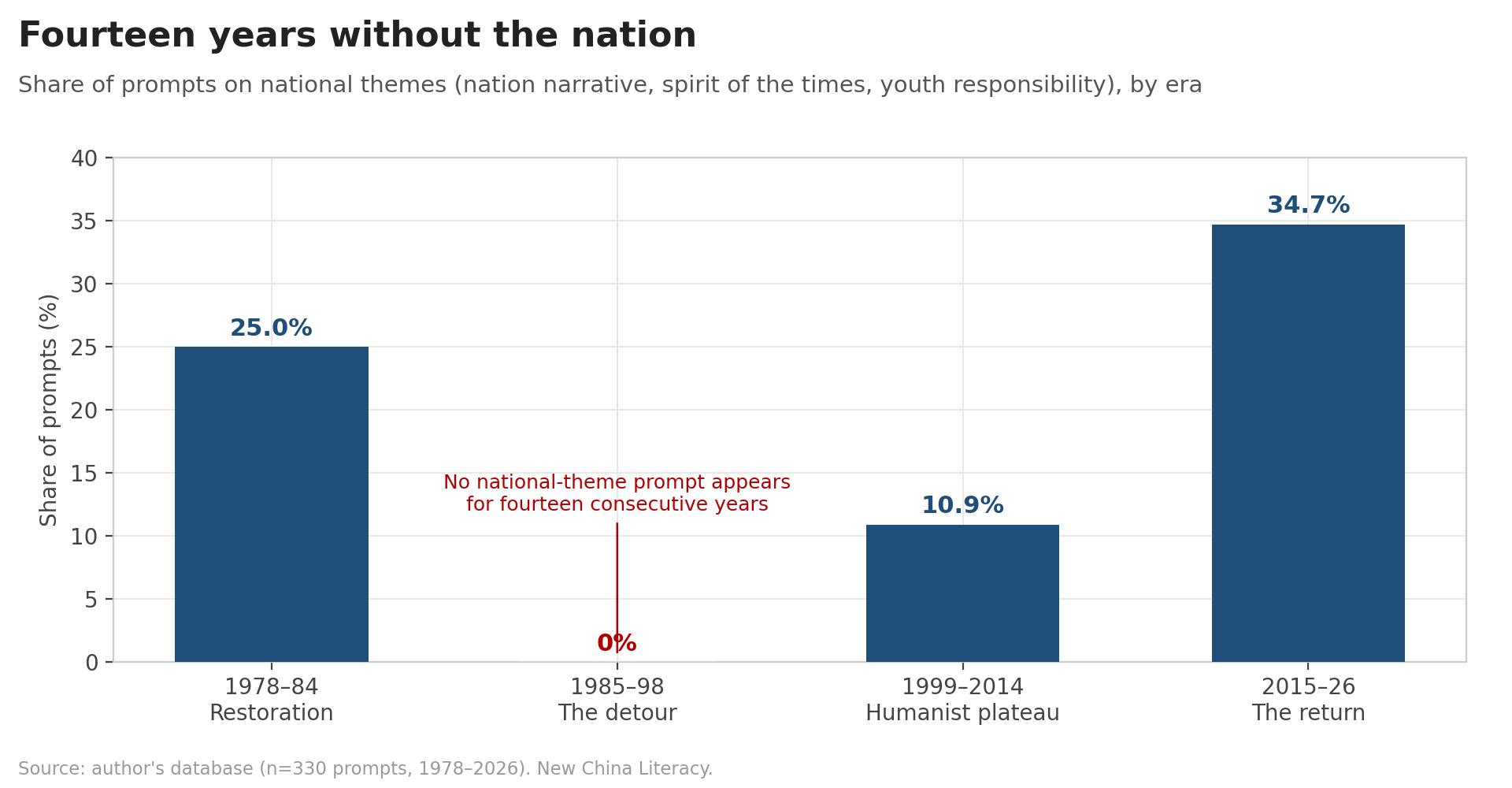
But almost immediately something older resurfaces. By 1980 the national prompt asks candidates to respond to the anecdote of the young Leonardo drawing eggs, and 1981 assigns a reflection on “Destroying a Tree Is Easy, Planting One Is Hard.” Literature and parable each supply a quarter of prompt materials in this period. The exam of the early reform years teaches values the way a village schoolteacher does, through stories about diligence and patience, with the political frame receding into the background season by season. The share of prompts on explicitly national themes, which I tag as nation-narrative, spirit-of-the-times, and youth-responsibility topics, stands at 25 percent in this first period. Then it does something almost no one remembers.
The long detour from the nation, 1985–1998
For fourteen years, the national theme share is zero.
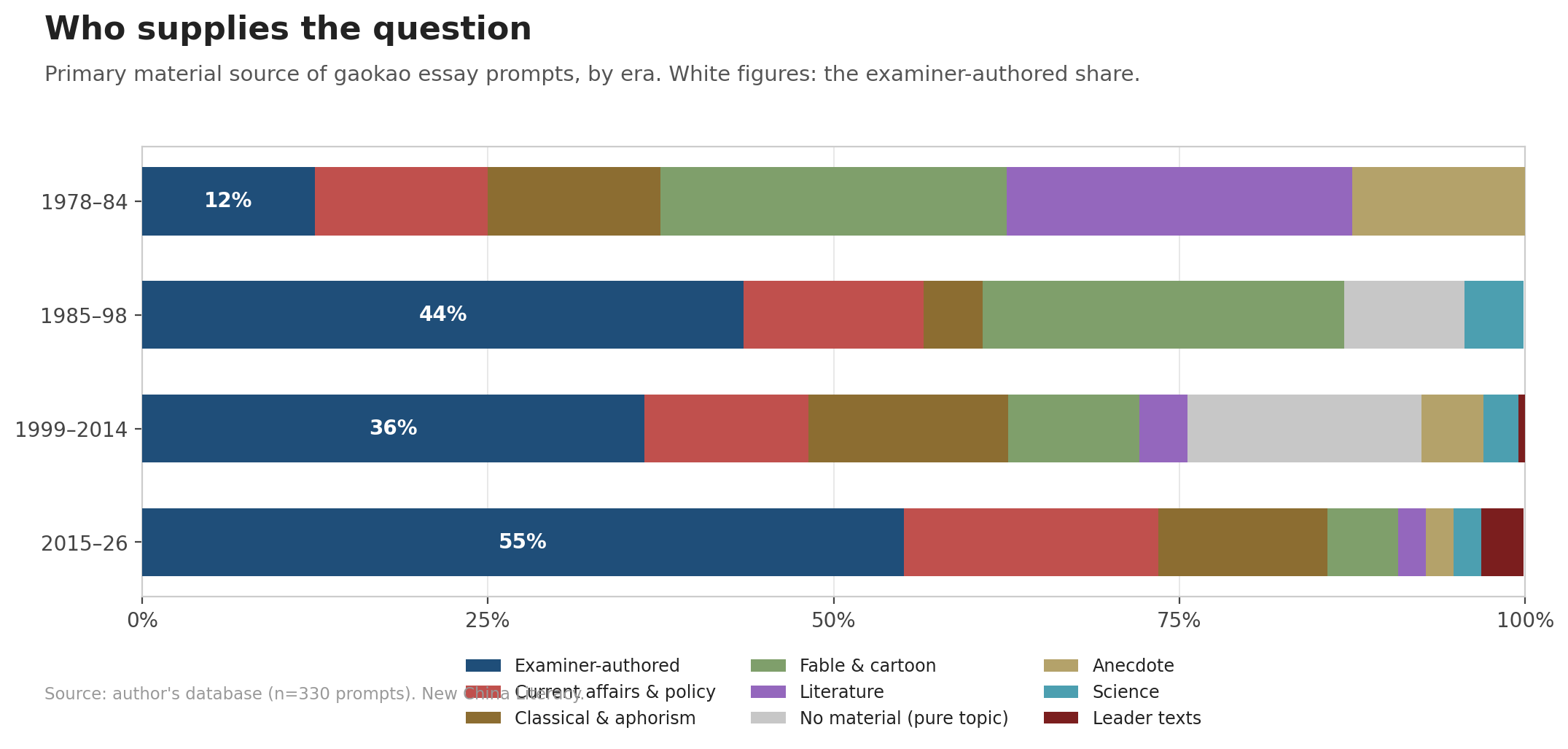
Not low. Zero, across every prompt in the corpus from 1985 to 1998. The examination of the high reform era asks about a chemical plant polluting a river (1985, in the form of a letter to a newspaper), about whether proximity to ink must stain (1991, staged as a formal debate), about two girls in a rose garden disagreeing over whether this is a good place because every thorn has a flower or a bad place because every flower has a thorn (1990). Fables and cartoons carry 26 percent of prompt materials; the examiner’s own invented scenarios carry 44 percent. The moral curriculum is dense, but its objects are civic and interpersonal: pollution, professional ethics, helping strangers, judging character.
This is the period the linear narratives cannot accommodate. The story told both by nationalist pedagogues and by many Western observers is one of continuous, gradually tightening ideological instruction. The prompt corpus says otherwise: between the ideological restoration of the late seventies and the ideological return of the mid-2010s lies a long plateau in which the state, examining its young at the most sensitive gate it controls, chose for fourteen consecutive years not to ask about itself. Whatever else the nineties were in Chinese intellectual life, at this particular altar the nation was simply not on the syllabus.
The humanist plateau, 1999–2014
In 1999 the national prompt asked: “If memory could be transplanted, what then?” It is hard to overstate how strange this question is in the lineage that produced it. No material to summarize, no moral to extract, no genre requirement, no correct answer conceivable. My prescriptiveness measure, averaged across the national paper series, falls from 3.0 in 1978 to 1.0 in the years 1999 through 2003, the lowest sustained reading in the half century.
The topic-essay era, as it was called, coincided with the devolution of exam-setting: at the peak, more than a dozen provinces wrote their own papers, and the provincial papers pushed the philosophical register furthest. Shanghai, which had set its own essay since 1985, developed a house style of pure speculative antinomy: in 2011 it offered two contradictory inscriptions, “everything passes” and “nothing ever passes,” and asked for the candidate’s own thinking. Classical sources return in this period (14 percent of materials, the highest since the exam’s restoration), pure no-material topics reach 17 percent, and the option to write in any genre covers 92.7 percent of prompts. Nation-themed prompts creep back to 10.9 percent, but the tone is reflective rather than declarative.
One thing, however, hardens exactly while everything else loosens. It is in this freest period that the eight-hundred-character floor becomes universal, the median minimum rising from six hundred characters and never coming back down. The genre acquires its permanent physical constitution at the moment of its maximum intellectual openness: freedom in content, standardization in form. Keep that trade in mind. It returns at the end of this story, inverted.
The return, 2015–2026
The pivot year is legible in a single prompt. In 2015 the national new-curriculum paper presented a news item about a daughter who reported her own father to the police for using his phone on the highway, and instructed candidates to write a letter to one of the parties. A task, a role, a stance to adopt: the task-driven essay had arrived, and prescriptiveness on the national series climbs back toward 3.0 by mid-decade.
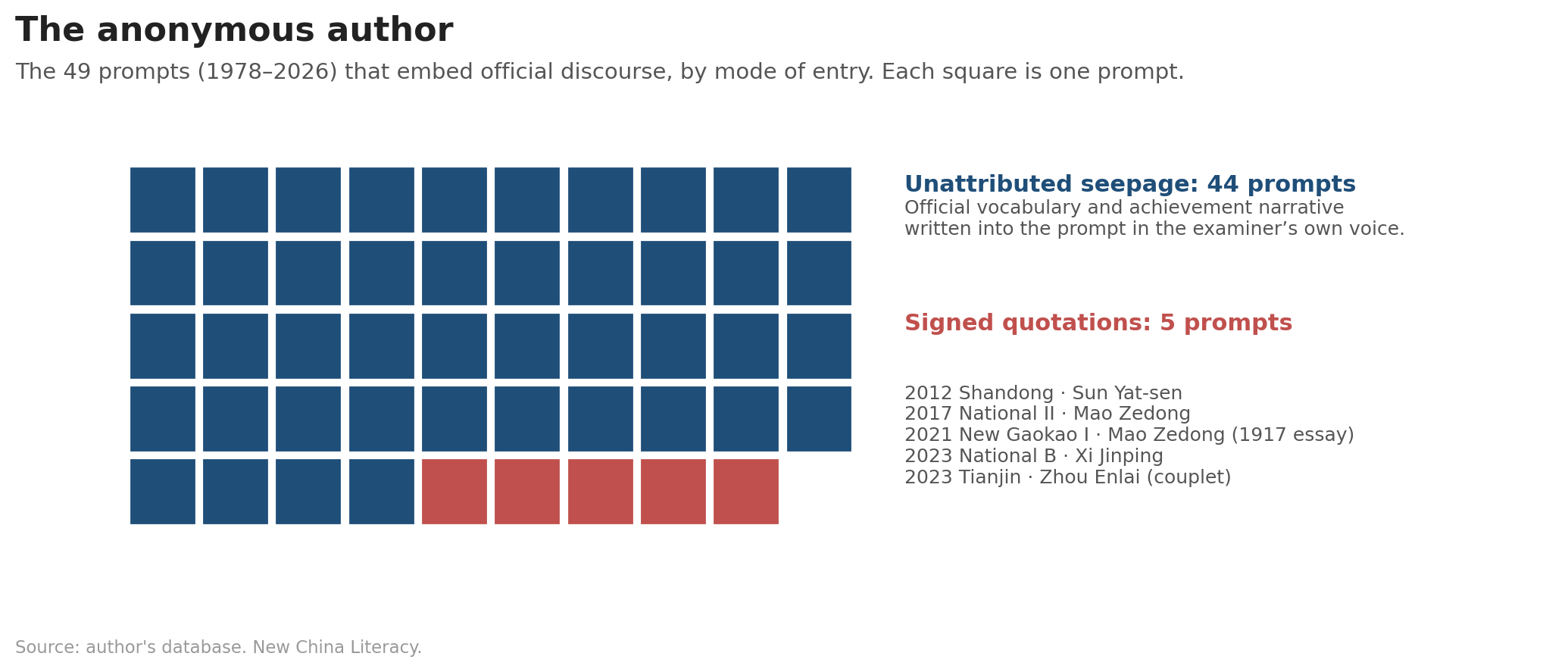
What returns with the task is the nation. National themes reach 34.7 percent of prompts in this period, the highest of the four eras and above even the restoration years. The 2021 prompt for the Party’s centenary embeds “great struggle” and “great rejuvenation” in its material and asks for an essay on “a time in which much can be done.” Materials drawn from news, policy prose, surveys, and official data rise to 18 percent. Fable and cartoon fall to 5 percent; literature, which supplied a quarter of materials in 1980, is down to 2 percent. And in 2023 something happens that had never happened on a national paper: the prompt quotes two passages and names their author, “General Secretary Xi Jinping,” on the face of the exam. In the whole corpus there are only five signed quotations of political figures, and the other four are historical: Sun Yat-sen in Shandong in 2012, the young Mao twice (2017, and his 1917 essay on physical education in 2021), the young Zhou Enlai’s couplet in Tianjin in 2023. The crossing from dead founders to the living leader occurs in 2023 and, so far, only once.
That is the narrative arc: restoration, detour, plateau, return. A micro-history of intellectual agendas in four rooms. But narrative arcs are cheap, and the point of building a database rather than a reading list is to ask the mechanical question underneath: when official discourse does enter the prompt, what carries it there?
What carries the state into the question
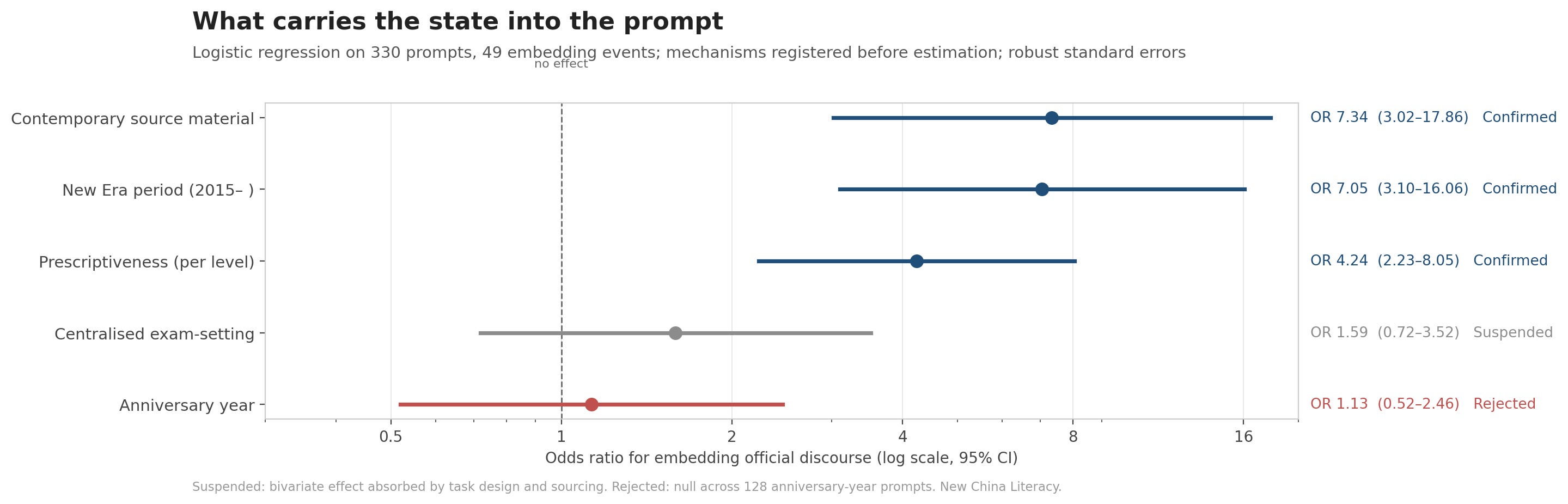
I ran the corpus through a structured attribution exercise: outcome and candidate mechanisms locked before any statistic was computed, descriptives, bivariate tests, then a logistic regression on the 330 post-1977 prompts, of which 49 embed official discourse. Five mechanisms went in. Three survived. Two, including the ones most observers would bet on, did not.
The first confirmed channel is the era itself. Holding everything else constant, a prompt written after 2015 has roughly seven times the odds of embedding official language as one written before (odds ratio 7.05). This sounds circular and is not: it means that even at the same prescriptiveness, with the same kind of source material, the same question written in a different decade carries a different probability of the state’s vocabulary. Mannheim’s existential boundedness of thought, usually a seminar abstraction, is here a coefficient.
The second is the source of the material, and it is the strongest variable in the model. Prompts built on contemporary authority, meaning news, policy prose, surveys, charts, embed official discourse half the time; prompts built on everything else, 9 percent of the time. Controlled, that is a sevenfold difference in odds (7.34), rising to nearly twelvefold within the post-2015 era alone. Classical texts, parables, and the examiner’s own philosophical scenarios function as insulation; topicality functions as a carrier wave. Shanghai’s long record of low embedding is not a mystery of regional liberalism, it is a sourcing decision, sustained for decades.
The third is the coupling of discipline and discourse. Embedding rises monotonically with prescriptiveness: 2 percent of open prompts, 11 percent of moderately framed ones, 51 percent of strongly tasked ones, about a fourfold jump in odds per level (4.24). The instruction is the pipeline. An open question is, structurally, a poor vehicle for a message; a task with a role and a stance is a good one. This is also where the corpus speaks to its Ming and Qing ancestor. The discipline of the eight-legged examination essay lay less in any particular quotation than in its task structure, the requirement to speak in the voice of the sages. The modern prompt reproduces the mechanism: what carries ideology is not the citation but the assignment.
Now the two that failed. The centralization of exam-setting, the recall of provincial papers into a national series over the 2014–2022 period, looks in the raw data like an ideological driver (national-series prompts embed at three times the provincial rate) and dissolves under controls (odds ratio falls to 1.59, statistically indistinguishable from nothing). The apparent effect of who writes the exam is absorbed by how the exam asks: task design and source choice. I hold this as suspended rather than refuted, since the data cannot separate a direct effect from one routed through technique. But the working conclusion matters for anyone who reads institutional recentralization as ideology by itself: recentralization loaded the gun; the trigger is a technical decision about prompt construction.
The cleaner failure is anniversary politics. It is an article of faith among China watchers that the political calendar governs everything, and 128 of the 330 prompts fall in decennial anniversary years of the Party’s founding, the People’s Republic, May Fourth, the launch of reform, or the war’s end. Their embedding rate is statistically indistinguishable from all other years (odds ratio 1.13). The propaganda system runs on anniversaries. The examination system, on this evidence, does not. Whatever coordination exists between the two is looser than the signal-readers assume.
The anonymous author
Here is the finding I did not expect, and the one I would ask you to keep if you keep only one.
Of the 49 prompts that embed official discourse, 44 do so without attribution. The vocabulary of the state, “cultural confidence,” “great rejuvenation,” “a nation’s soul,” the triad of “changes in the world, the times, and history” lifted straight from the Twentieth Congress report into the 2026 prompt, arrives in the prompt as the examiner’s own prose. Across the four eras, the examiner’s self-authored scenario is the single largest source of prompt material, and its share peaks now, at 55 percent, precisely in the period of maximum embedding. The signed quotation, the form everyone noticed in 2023, accounts for five prompts in forty-eight years.
On the face of the examination, in other words, the state speaks as an anonymous author. It does not, in the main, quote itself. It composes. The leader’s language is absorbed into the voice of an unnamed examiner and presented to thirteen million readers as the neutral frame within which their own thinking is to occur. This is a more interesting operation than quotation, and a more effective one: a quotation can be bracketed as someone’s utterance, while a frame is simply the world of the question.
It also has a direct methodological consequence for how China is read from outside. The standard Western instrument for tracking ideology in Chinese texts is quotation-counting and slogan-spotting: who is cited, which formulations appear. Applied to this corpus, that instrument captures roughly one-tenth of the traffic. I ran a fixed 26-term lexicon of official vocabulary against every prompt as a machine check on my own coding; it agreed with the human coding 91 percent of the time, but it missed 28 of the 49 embeddings, most of them narrative rather than lexical: the space program, the pandemic mobilization, the Olympic double, national achievement told as story without a single flagged term. Slogan-tracking gives you a lower bound, and not a tight one. The load-bearing layer is anonymous authorship and task design, and it is invisible to the citation index.
After 2023: quieter words, harder forms
The last four years complicate the return narrative from inside. On the national series, the embedding rate falls from 59 percent in 2015–2022 to 36 percent in 2023–2026, and average prescriptiveness falls from 2.6 to 1.7. The 2024 prompts ask about artificial intelligence and the shrinking of questions, about candid conversation; 2025’s flagship prompt builds on Lao She, Ai Qing, and Mu Dan. I flag honestly that the sample is small (27 prompts against 11) and the difference does not clear statistical significance; call it a softening signal, not a softening fact.
But watch what does not soften. The requirements sentence at the bottom of the prompt, the fine print nobody anthologizes, reaches its maximum standardization exactly now: no plagiarism (56 percent of full-text prompts), no formula-writing (42 percent), no disclosure of personal information (33 percent, a clause that exists only in this era), choose your own title, make the genre explicit, select an accurate angle, eight hundred characters. The era’s requirement block reads like a statute, and it is the densest statute in the corpus’s history. And 2025’s flagship prompt, lexically clean on its face, is saturated in the official explication published alongside the answers, where the exegesis supplies “a nation’s soul” that the prompt itself withheld.
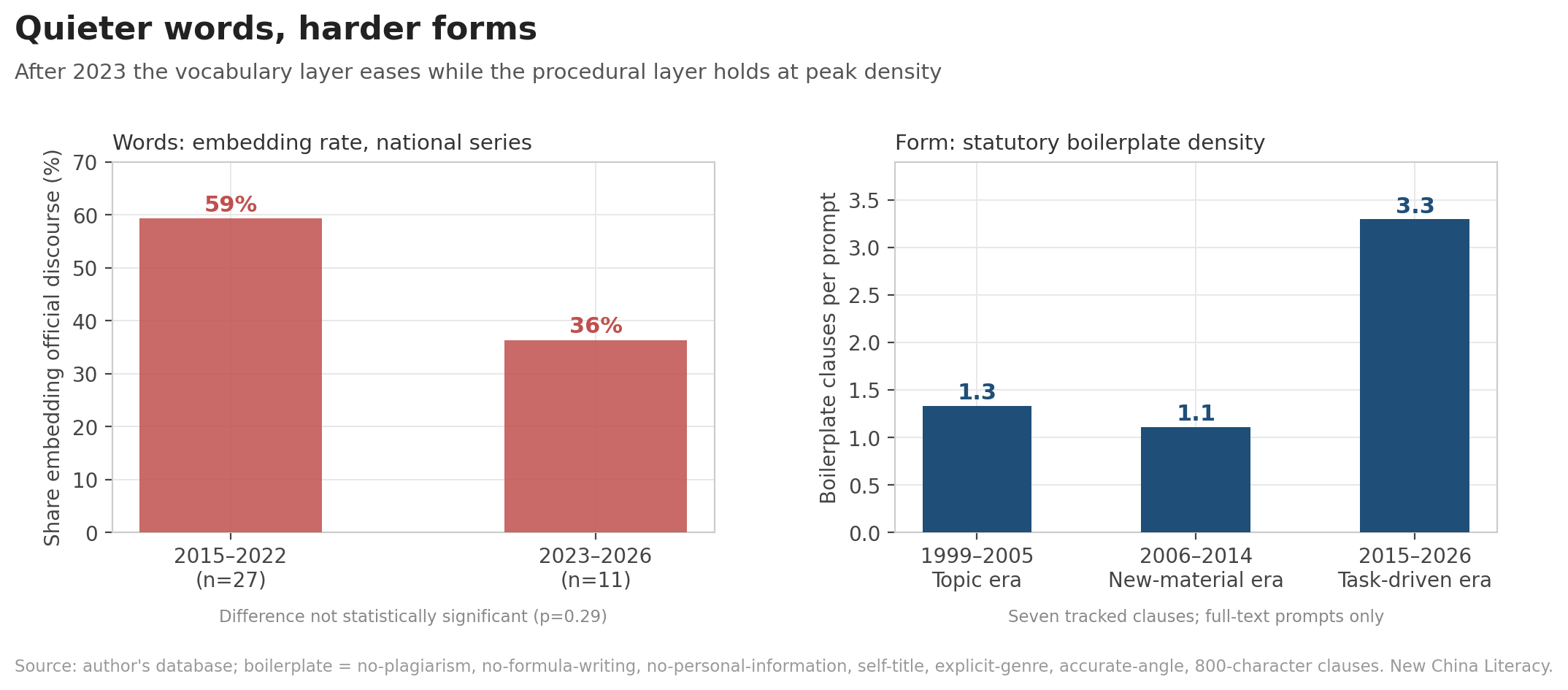
Put the two movements together and the present moment resolves into a dissociation: the vocabulary layer is easing while the procedural layer hardens. If the pattern holds through the next two or three Junes, the gaokao essay will have entered a third form, lexically neutral and procedurally rigid, in which control has migrated from what may be said to how saying is organized. The mid-century form told you the thesis. The current form increasingly declines to tell you the thesis and instead specifies, in statute-grade detail, the container. Neither the tightening narrative nor the liberalization narrative has a name for this, in English or in Chinese, and the naming rights are still available.
How to read next June
For readers who want to check this rather than take it on faith, the diagnostic is cheap and repeatable. Each June, run a fixed lexicon over the prompts, but score two layers separately: the prompt face and the official explication released with the answer keys. In 2025 the face scored zero and the exegesis scored saturated; the explication layer leads the prompt layer, and the lag between them is the observable interface between the ideology apparatus and the examination bureaucracy. Track two annual series against the baselines this database now provides: the clause count of the requirements sentence, and the share of examiner-authored material. Both moved before policy documents did in the last two transitions. And keep a standing file on signed quotations. The base rate is five in forty-eight years. The next one, whoever is quoted, will be a data point of the rarest kind this corpus produces, and the two dimensions worth coding on arrival are whether the figure is historical or incumbent, and whether the text is juvenilia or an utterance in office.
A state examines its young where its anxieties live. For fourteen years it asked them about rivers and rose gardens; for a decade it has asked them, with increasing frequency and now decreasing volume, about itself. The question was never only a question. It is the most honest annual publication the modern Chinese state has, precisely because it is written by no one, signed by no one, and read by everyone.
Notes on data and method. The corpus is a 338-prompt database (1978–2026, plus the 1977 restoration set) built from examination-authority releases and period compilations, coded for prescriptiveness (1–3), official-discourse embedding (none / unattributed / signed), material source, theme, genre and length requirements, with a three-level text-fidelity flag; 182 entries remain marked for archival verification against original papers, and the 2026 set is coded from contemporaneous online releases. The attribution analysis is a logistic regression on 330 prompts (49 embedding events; robust standard errors; pseudo-R² 0.376; events-per-variable 9.8, at the conventional floor), with mechanisms registered before estimation; a 26-term lexicon check on the single-coder embedding variable yields 91 percent agreement, kappa 0.54, and should be read as a lower bound. The full database, the stage-by-stage attribution workpapers, and a companion Chinese report are available on request. A note for the record: the softening observation for 2023–2026 rests on eleven prompts and does not clear significance; it is offered as a hypothesis with a date on it, not a conclusion.