

Watching the Watchers
How a Diplomatic Phrase Activated China’s America-Research Apparatus


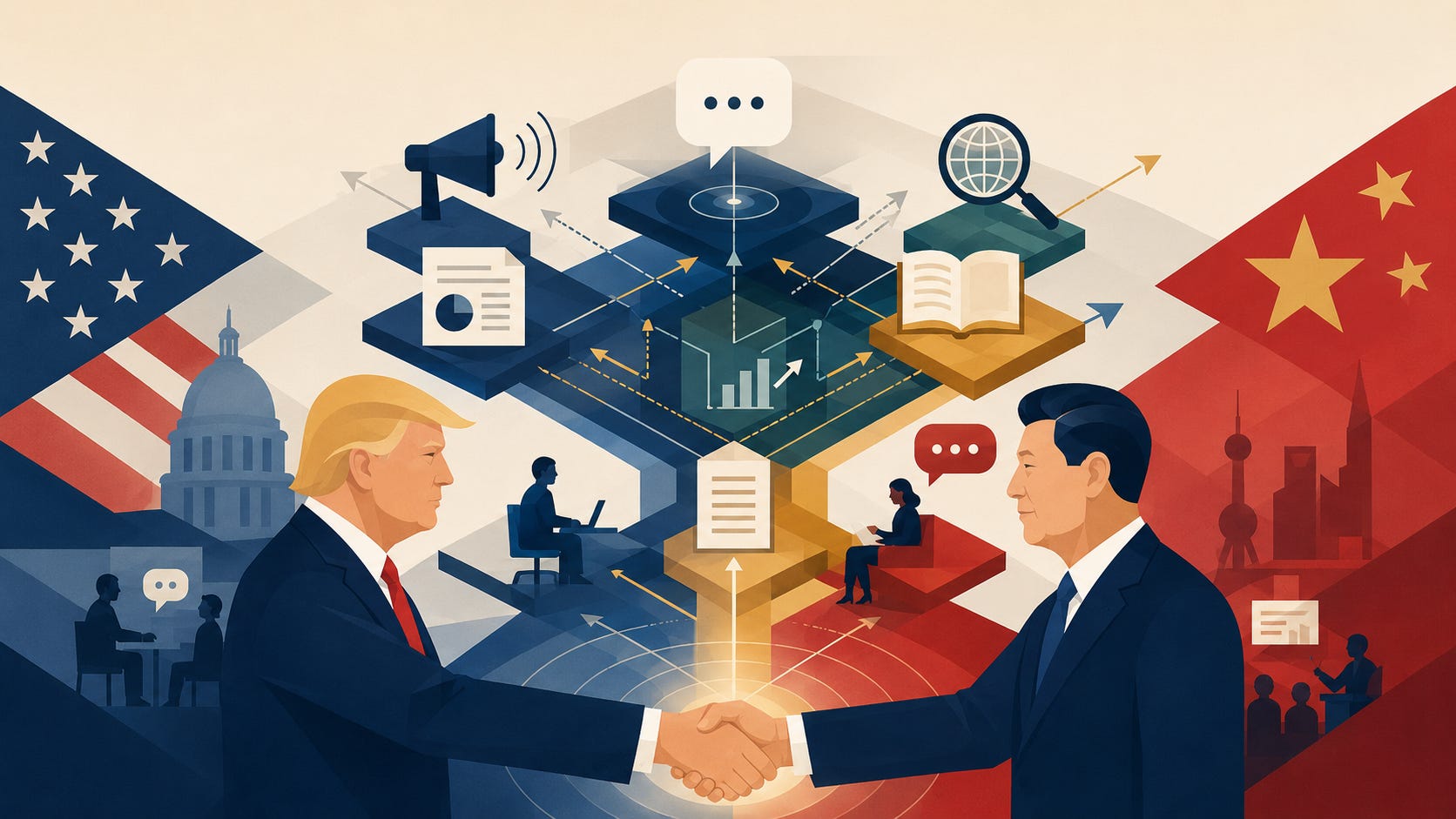
The Trump–Xi summit of 13–15 May 2026 produced little conventional substance: a procurement list, a phrase, a handshake. Yet the phrase—“a constructive China–U.S. relationship of strategic stability”—mattered, because it activated a system. Within a week, forty-some commentaries by Chinese scholars had appeared (Mardell 2026); the China Institutes of Contemporary International Relations (CICIR) had released an analytical report timed to Trump’s arrival day, before any readout was public; and four authoritative state articulations of the formula were released within twelve hours of Xi Jinping’s first formulation. The empirical density is unusual. The speed of assembly is more so.
The Chinese commentary wave should be read not as a market of expert opinion but as institutional evidence: doctrine was released, diagnosis supplied, expert elaboration distributed, and audience-specific translation activated. The stakes are methodological. How analysts read Chinese expert commentary affects whether they mistake controlled tactical variation for independent policy debate, and that mistake shapes how Washington reads Beijing’s flexibility on Taiwan, export controls, AI governance, cross-border investment, and crisis diplomacy. The summit matters less as diplomacy than as the case that makes the method visible.
Four functions, one performance
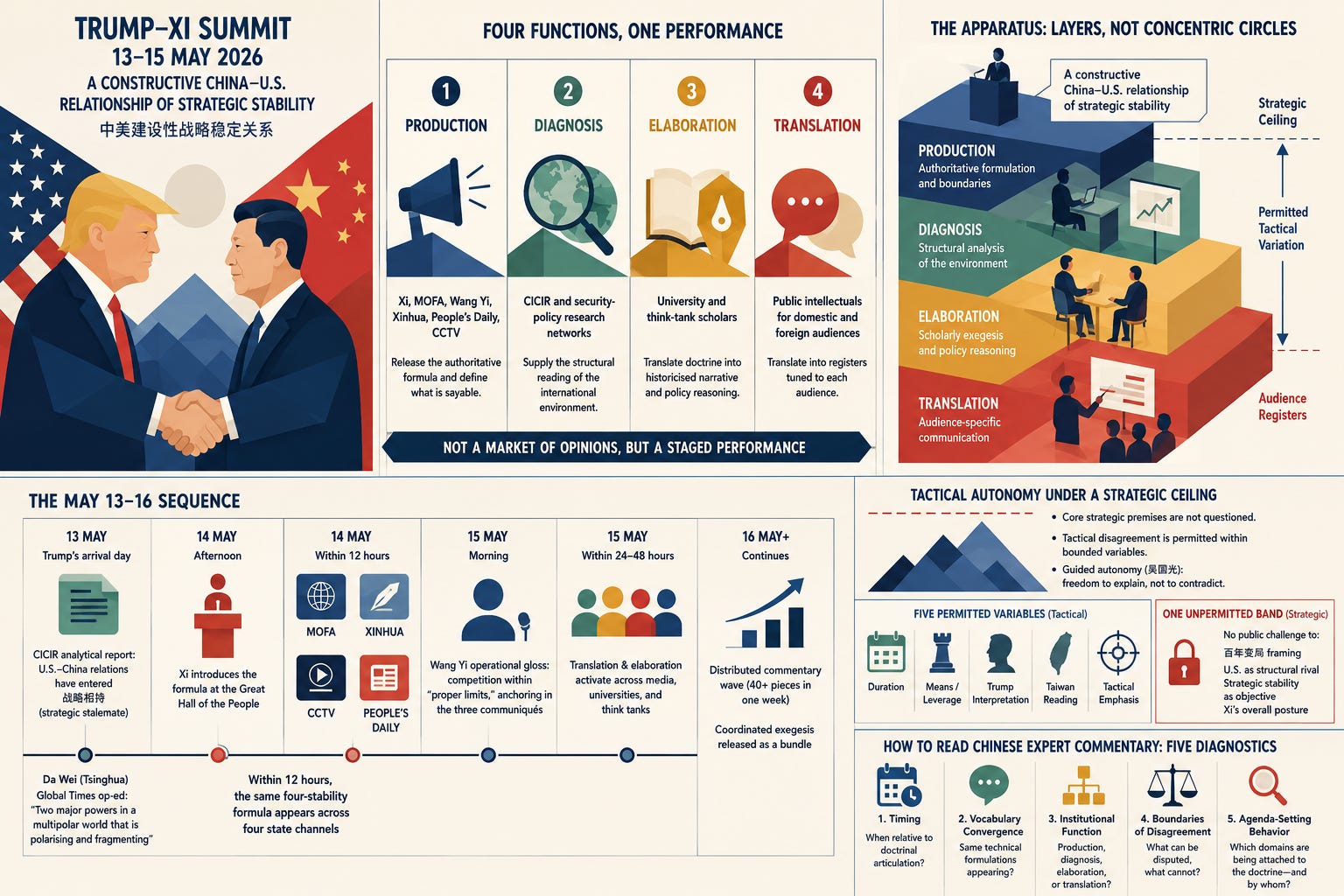
Four functions, performed in four layers, structure the apparatus. Production is the work of Xi himself, the Ministry of Foreign Affairs (MOFA), Wang Yi, Xinhua, the People’s Daily, and China Central Television (CCTV)—the channels that release the authoritative formula and define what is sayable. Diagnosis is the work of CICIR and security-policy research networks, the layer that supplies the structural reading of the international environment. Elaboration is the work of university and think-tank scholars who translate doctrine into historicised narrative and policy reasoning. Translation is the work of public intellectuals addressing domestic and foreign audiences in registers tuned to each. The four functions are not concentric circles radiating from a sovereign centre. They are stages in a single institutional performance, and what looks like a market of opinions is largely the third and fourth layers extending what the first two have set.
Tactical autonomy under a strategic ceiling
Chinese America-watchers are neither pure propagandists nor independent analysts. Wu Guoguang’s concept of “guided autonomy” captures this space: tactical disagreement is permitted, but the Party’s core strategic premise is not questioned (Wu 2026). The May 2026 corpus shows the concept as observable phenomenon, not static condition: rapid calibration to a new authoritative line, audience segmentation across registers, coordinated exegesis released as a bundle. What turns the dynamic visible is the formula itself. The phrase “a constructive China–U.S. relationship of strategic stability” (中美建设性战略稳定关系) functions as doctrine, not merely as one more diplomatic tifa, because it sets boundaries, orders interpretation, and gives later commentary a frame to extend rather than contest. The formula was bilateral in diplomatic form—both Washington and Beijing adopted it in their readouts—but doctrinal only in its Chinese domestic-expert circulation. Washington appears to have treated the words instrumentally; Beijing invested them with architecture.
The May 13–16 sequence
The strongest empirical material here is chronological. On 13 May, Trump’s arrival day, CICIR releases an analytical report framing U.S.–China relations as having entered 战略相持 (strategic stalemate) and requiring the framework Beijing would later render in English as the new doctrinal formula (Mardell 2026). On the same day, Da Wei of Tsinghua’s Center for International Security and Strategy publishes a Global Times op-ed framing the moment as “two major powers in a multipolar world that is polarising and fragmenting” (Da 2026). On the afternoon of 14 May, Xi introduces the formula at the Great Hall of the People. Within twelve hours, the same four-stability formula appears across four distinct state channels: the MOFA spokesperson briefing (MOFA 2026), a Xinhua commentator essay, a CCTV 央视快评 piece, and the People’s Daily 钟声 commentator essay scheduled for the 16 May front page. On the morning of 15 May, Wang Yi delivers the operational gloss—competition within “proper limits,” anchoring in the three communiqués (Wang 2026).
On the same day, translation and elaboration activate. Wu Xinbo on PBS NewsHour tells an American audience that China and the United States now “look at each other even” (PBS NewsHour 2026). Jin Canrong on Guancha runs the populist domestic version: “China won equality through strength” (Jin 2026). Within 15–16 May, Shen Yi of Fudan supplies a six-phase historicisation in Guancha, tracing the formula back through 1997’s “constructive strategic partnership” and 2013’s “new type of major-country relations” to position 2026 as phase six (Shen 2026); Diao Daming of Renmin University supplies a roadmap framing in The Paper, arguing that if “general stability” since Busan meant “no more freefall,” the new framework is “doing additions on top of that base” (Diao 2026). Zheng Yongnian, an opinion leader affiliated with several institutions, including the Qianhai Institute for International Affairs (IIA) at the CUHK, has elevated this new concept to the level of a new paradigm in international relations, given its apparent significance in transcending the “Thucydides Trap”.
The timing itself is the evidence. A diagnostic report on the arrival day, before any readout was public. A doctrinal release the next afternoon. Four state channels carrying near-identical wording within twelve hours. An operational ministerial briefing within twenty-four. Distributed scholarly elaboration and audience-segmented translation within forty-eight. This does not prove a single command chain; it shows public-pattern coordination through synchronised timing, repeated vocabulary, differentiated roles, and stable boundaries of disagreement.
Function shapes register
Beyond timing and convergence, the May corpus reveals something subtler about how the track-two think tank world shapes the voices that emerge from it. The institutional environment in which a Chinese America-watcher operates does not just influence what they can say. It shapes how they say it, and what subject they choose to say it about. The intuitive Western map—diplomats are emollient, intelligence officers are hawkish—does not fit.
Track-two work rewards the opposite: scholarly exchange that serves information-gathering and relationship-management requires access, credibility, and plausible deniability; firmness destroys the medium (Wu 2026). Track-two Chinese America-watchers from several institutions, which exist in significant part to sustain channels: to American interlocutors at Track-1.5 dialogues, to foreign embassies in Beijing, to international press, and upward to the foreign-policy bureaucracy that consumes their analysis. That access requires a particular voice—firm but not strident, doctrinally legible but analytically substantive, capable of explaining Chinese positions persuasively to outsiders without breaking with the authoritative line. The combative register associated with public diplomacy under Xi is incompatible with this medium; it destroys the working relationships that make the analytical output possible. Da Wei of Tsinghua, who came up through CICIR, sits squarely in this register. His framing of the moment as “two major powers in a multipolar world that is polarising and fragmenting” carries the diagnostic firmness the doctrinal layer requires while remaining the sort of formulation an American counterpart could engage with at a closed dialogue. Across the broader May corpus,track-two scholars writing in foreign-facing venues converge on a similar tonal range: declarative on premises, granular on mechanisms, restrained in rhetoric. Where rhetorical assertion appears—and it does, prominently—it has migrated into the translation layer, where Jin Canrong of Guancha populism can make claims with a force that would damage a track-two scholar’s working relationships.
The bid runs in two directions, and they are easily confused. The passive form is mundane: a sectoral researcher inside a larger think tank is instructed to produce the domain-specific exegesis, and the doctrine flows downward into whichever area their programme covers. The active form is more interesting. Domain specialists—people whose careers are built around AI safety, outbound investment screening, or financial-system dialogue—have a direct stake in being the ones who define what the new framework means for their field. Doing so attracts research funding, generates invitations to second-track exchanges, and concentrates policy attention on the area they work on. The doctrine becomes a vehicle for substantive agenda-promotion, and the boundary between elaborating Beijing’s priorities and constructing them is genuinely thin. The two patterns leave nearly identical fingerprints—sectoral commentary timed to the doctrinal release, anchored in the new vocabulary, delivered through the standard venues. The behavioural signature differs in degree rather than in kind: the active version tends to push implications further than the central articulation explicitly endorsed, and to argue with more energy that the doctrine requires attention to its particular domain. Distinguishing them takes careful reading rather than a clean test.
What the apparatus permits and what it does not
A non-trivial share of the May corpus does not really diagnose the overall relationship at all. It uses the formula as a lever to claim that “constructive strategic stability” carries specific implications for a particular domain, like AI governance, cross-border investment regimes, green finance, technology standards, two-way market access. Commentary of this kind reads quite differently from the structural diagnoses produced by the diagnostic layer. It is making a quieter bid: that this substantive question is what the doctrine should be taken to govern next.
Across more than fifty named commentators in the week after the summit, the variance falls into permitted and unpermitted bands. The permitted variables are five: duration (a three-year window versus a structural-bipolar fait accompli); means (“trump cards” of rare earths, Treasuries, and market access versus tactical stabilisation); Trump interpretation (structurally weakened, transactionally pliable, or genuinely shifting); Taiwan reading (cautious optimism versus scepticism on whether U.S. signals indicate retreat); and tactical emphasis (escalation, consolidation, or wait-and-see). The unpermitted band is single and structural: no senior figure publicly questions the 百年变局 framing, the periodisation of the United States as China’s structural rival, the desirability of strategic stability as a Chinese objective, or the legitimacy of Xi’s overall posture. The bounded variance is precisely what guided autonomy predicts: the mechanism rewards tactical disagreement and disciplines strategic disagreement. The question to ask of any individual scholar is therefore not “what does this person think?” but “where does this person sit on the permitted spectrum, and what does the spectrum’s shape reveal?”
How to read Chinese expert commentary
If the institutional reading is correct, it implies an operational method. Foreign analysts should track five things rather than chasing individual scholarly opinions. First, timing: when does a substantive analytical piece appear in relation to a doctrinal articulation? Second, vocabulary convergence: is the same technical formulation appearing across actors who do not normally coordinate by accident? Third, institutional function: which of the four roles—production, diagnosis, elaboration, translation—is the actor performing in a given venue? Fourth, boundaries of disagreement: which variables are scholars permitted to dispute, and which strategic premises is no one disputing? Fifth, agenda-setting behaviour: which sectoral domains are scholars choosing to attach the new doctrine to, and is the attachment being made by domain specialists with a professional stake in claiming territory under the doctrine? The active form of sectoral elaboration is an indicator of which questions are likely to enter the formal agenda next, not a confirmation that they already have.
The method generalises to future waves of Chinese expert commentary on Taiwan, technology controls, AI governance, and crisis diplomacy. Reading individual scholars without these diagnostics produces either over-personalisation or naive aggregation. Reading them with these diagnostics produces a map of where the strategic ceiling has been set and where tactical variation is being permitted. The Beijing summit did not only name a relationship. It revealed the institution that makes such naming usable. To watch the watching is not to catalogue Chinese views of America. It is to identify the ceiling, channels, and choreography through which those views become politically usable.
Guest author: Wenxiang He is a researcher working on American studies, U.S.–China relations, technology politics, and global governance. He has served as a research assistant at the Fudan Development Institute, the Shanghai Institute of American Studies, CISS Youth, and the National Institute of Strategic Studies at Shanghai Jiao Tong University, contributing to policy reports, public commentaries, and research projects on U.S. politics, major-power competition, digital governance, AI regulation, cybersecurity, and critical technologies. His recent work has examined issues including TikTok’s U.S. restructuring proposal, the EU AI Act, U.S.–China strategic competition, critical minerals, and technology decoupling. He is going to pursue graduate studies in international relations at Fudan University, following his undergraduate training in international relations at Jinan University.
References
Da, Wei. 2026. Comments to Global Times, May 13, 2026. https://www.globaltimes.cn/page/202605/1360929.shtml.
Diao, Daming (刁大明). 2026. “从‘总体稳定’到‘建设性战略稳定’, 如何看待中美关系的新定位?” [From ‘General Stability’ to ‘Constructive Strategic Stability’: How to View the New Positioning of China–U.S. Relations]. The Paper (澎湃新闻), May 14, 2026. https://www.thepaper.cn/newsDetail_forward_33179484.
Jin, Canrong (金灿荣). 2026. “中美关系新定位背后, 是中国用实力赢得了平等” [Behind the New Positioning of China–U.S. Relations Is China Winning Equality Through Strength]. Guancha (观察者网), May 15, 2026. https://www.guancha.cn/JinCanRong/2026_05_15_817093.shtml.
Mardell, Jacob. 2026. “Trump–Xi Summit: Chinese Analysts on the New Strategic Stalemate.” Sinification, May 19, 2026. https://www.sinification.org/p/trump-xi-summit-chinese-analysts.
Ministry of Foreign Affairs of the People’s Republic of China (MOFA). 2026. “Foreign Ministry Spokesperson Guo Jiakun’s Regular Press Conference on May 14, 2026.” May 14, 2026. https://www.mfa.gov.cn/fyrbt_673021/202605/t20260514_11910530.shtml.
PBS NewsHour. 2026. “Trump and Xi Pledge ‘Strategic Stability’ but Key Questions Remain Unanswered.” May 15, 2026. https://www.pbs.org/newshour/show/trump-and-xi-pledge-strategic-stability-but-key-questions-remain-unanswered.
Shen, Yi (沈逸). 2026. “中美‘建设性战略稳定关系’将如何指引两国与世界的未来?” [How Will China–U.S. ‘Constructive Strategic Stability Relations’ Guide the Future of the Two Countries and the World?]. Guancha (观察者网), May 16, 2026. https://www.guancha.cn/ShenYi/2026_05_16_817212.shtml.
Wang, Yi. 2026. “Briefing by Foreign Minister Wang Yi on China–U.S. Summit and Common Understandings.” Ministry of Foreign Affairs of the People’s Republic of China, May 15, 2026. https://www.fmprc.gov.cn/eng/wjb/wjbz/jh/202605/t20260516_11911719.html.
Wu, Guoguang. 2026. Guided Autonomy: America Watching in Xi’s China. New York: Asia Society Policy Institute, Center for China Analysis. https://asiasociety.org/policy-institute/guided-autonomy-america-watching-xis-china.
Zheng, Yongnian (郑永年). 2026. “对话郑永年:这不仅是中美关系‘新定位’,更是国际关系‘新范式’!”[A Dialogue with Zheng Yongnian: This Is Not Merely a “New Positioning” for Sino-US Relations, But a “New Paradigm” for International Relations!]. Greater Bay Area Review(大湾区评论)from IIA, May 16, 2026. https://finance.sina.com.cn/wm/2026-05-15/doc-inhxytzk3184726.shtml
 | A guest post by
|
Absolutely brilliant.